Banner Line
U.S. Defense Secretary Visits Vietnam
At a news conference Monday with Vietnamese Defense Minister Gen. Phung Quang Thanh, Mr. Panetta said he hopes to strengthen the U.S. defense relationship with Vietnam and help the country’s military to develop.
Mr. Panetta said he and Gen. Quang Thanh discussed additional high-level dialogues and increased visits to Vietnam by U.S. Navy ships.
“The whole thrust of what we discussed in our meeting is to try to take this relationship to a new level,” Mr. Panetta said.
But Vietnam, keen to guard its independence, is moving gingerly. Gen. Quang Thanh said his country wants good relations with both China and the United States.
“We do not depend on any country,” Gen. Quang Thanh said.
U.S. officials have worried in the past about China’s actions in the South China Sea and have said they believe if they don’t help other nations in the region to improve their militaries, China will come to intimidate smaller countries.
Mr. Panetta said the U.S. wants to help strengthen Vietnam and other nations, which he said would help to increase regional stability.
“The goal of the United States is to advance exactly what the general refers to: advance the independence and sovereignty of all nations in the region,” Mr. Panetta said.
For his part, Gen. Quang Thanh said he wants the U.S. to lift its ban on selling Vietnam lethal weapons. Congress currently allows some nonlethal military equipment to be sold to Hanoi.
Selling a wider range of weapons, Gen. Quang Thanh said, would “help fully normalize relations.”
Mr. Panetta did not explicitly comment on the arm-sales issue, but noted that “assistance” to Vietnam will have conditions.
“That additional assistance depends on progress that is being made on human rights and other reforms,” Mr. Panetta said.
Source: The Wall Street Journal June 5,2012 ...Read more>>>
Human rights deteriorating in China, Vietnam, U.S. says
The judgments were made in the department's annual assessment of human rights in countries around the world, that also took aim in Asia at post civil-war Sri Lanka and vast penal labour camps in North Korea.
But the U.S. hailed "remarkable" improvements in military-dominated Myanmar, including releases of political prisoners and democracy leader Aung San Suu Kyi's participation in April special elections. It held up the country also known as Burma as an example of reform that it hoped could inspire change in other closed societies.
The report, which covers 2011, singled out China as a place in Asia where things had gotten worse. The government exercised tight control over the Internet, stepped up efforts to silence political activists and resorted to extralegal measures, including enforced disappearance and house arrest of family members, the report said.
Michael Posner, assistant secretary of state for democracy, human rights and labour, said the past several years have seen a "closing of space" for human rights lawyers and activists and China. He also voiced concern over repression of religious minorities and the self-immolations of Buddhist monks and nuns in Tibetan areas.
Among the Chinese activists singled out for mention in the report is blind lawyer Chen Guangcheng, who had campaigned against forced abortions and other abuses. His case has moved on dramatically since the report was drafted, following his escape from house arrest to the U.S. Embassy in Beijing last month. That triggered several days of frantic, closed-door diplomacy before Chen was allowed last week to travel to New York to study.
Posner said the U.S. was closely monitoring what is happening with Chen's elder brother and detained nephew, and lawyers and others who have supported them. But he stressed how the resolution of Chen's case demonstrated that the U.S. and China could address human rights without it derailing ties.
As its steps up engagement in Asia, the Obama administration has also cultivated relations with former enemy Vietnam. The report took aim at Vietnam's one-party rule and its restrictions on Internet content and bloggers. It criticized arbitrary arrests of peaceful activists and said more than 100 political detainees are currently held.
On North Korea, the report cited estimates that between 130,000-200,000 detainees are held in political, penal labour camps. It said based on satellite imagery, once such camp was thought to be 31 miles (50 kilometres) long and 25 miles (40 kilometres) wide and hold 50,000 inmates.
Defectors from the impoverished, closed country continued to report extrajudicial killings, arbitrary detention, severe punishment of some refugees and their family members repatriated after fleeing to China. It said many prisoners in political prison camps and the detention system were not expected to survive.
In Sri Lanka, the U.S. reported disappearances and killings by pro-government paramilitary groups, predominantly in minority ethnic Tamil areas. It referred to attacks, intimidation and harassment of civil society activists, journalists and persons viewed as sympathizers of the Tamil Tigers - the rebel group that was crushed after a 26-year civil war that ended in 2009.
"A disproportionate number of victims of human rights abuses were Tamils," the report said.
In Indonesia, widely viewed as the most democratic country in Southeast Asia, the U.S. still cited major human rights problems, including continuing arbitrary and unlawful killings by security forces and others in the restive provinces of Papua and West Papua.
The report noted the escalation in another of the region's democracies, Thailand, of prosecutions under the tough lese-majeste law, which carries up to 15 years in prison for insults of the nation's top royalty.
In the decade before 2006, there had been about five cases on average annually, but in 2010 there were 478 new cases, and in the first 10 months of 2011, 85 new charges. It said the overall conviction rate remained nearly 100 per cent.
Source: The Associated Press, Thursday May. 24, 2012 1:01 PM ET
...Read more>>>
Vietnam Still Abuses Human Rights and Religious Freedom
Dr. Robert P. George serves as a Commissioner on the U.S. Commission on International Religious Freedom (USCIRF). This article was adapted from Commissioner George’s testimony of May 15, 2012 before the Tom Lantos Human Rights Commission of the U.S. House of Representatives.
The U.S. Commission on International Religious Freedom (USCIRF) has testified before Congress on Vietnam numerous times over the past seven years. Before each appearance, USCIRF had hoped to bring news of dramatic changes; greater respect for universal rights; lifting draconian controls over free expression, religion, and association; and the cessation of the silencing of dissent. Sadly, the Commission cannot report such changes today. In fact, Vietnam has been backsliding on human rights for the past several years and religious freedom conditions remain very poor and are deteriorating.
Religious Freedom Conditions
The U.S.-Vietnamese relationship has grown rapidly in recent years, but it has not brought needed improvements in religious freedom and related human rights in Vietnam.
The government of Vietnam continues to control all religious communities in some manner, actively suppresses independent religious practice, and detains individuals viewed as challenging its authority, particularly those who publicly advocate for fewer religious freedom restrictions.
To be sure, religious activity continues to expand in Vietnam. The government has made important concessions over the past decade in response to international pressure, including the 2004 designation of Vietnam by the United States as a “Country of Particular Concern” or CPC for its severe religious freedom abuses.
Nevertheless, individuals continue to be imprisoned for engaging in independent religious activity or religious freedom advocacy; new converts to ethnic minority Christianity face discrimination, harassment, and forced renunciations of faith; and religious communities face violence from police and “contract thugs,” including Catholics peacefully protesting land disputes and forced disbandment of the “Plum Village” Buddhist order.
The most egregious violations have targeted the Unified Buddhist Church of Vietnam, independent Hoa Hao and Cao Dai groups; ethnic minority Protestants in the Central Highlands and northwest provinces; and ethnic Khmer Buddhists in the Mekong Delta.
Over the past year, there have been more than a dozen new arrests of ethnic minority Protestants and Catholics and two Hoa Hao activists who met with the Commission during 2009. Violence continues to occur, targeting Catholic communities protesting land confiscations and Hmong religious gatherings.
Relations between the Vietnamese government and Catholics, particularly clergy and laity affiliated with the Redemptorist Order, have deteriorated significantly in recent years. Peaceful protests in land disputes and prayer vigils to honor detained human rights defenders have led to violence by police and more than a dozen arrests. Ethnic minority Protestants continue to experience campaigns of forced renunciations of faith, focused on curtailing both independent religious activity and new converts. Fr. Nguyen Van Ly was also returned to prison last year after being given medical parole.
Recommendations for U.S. Policy
USCIRF is not alone in its conclusions about religious freedom conditions in Vietnam. Its assessments are shared widely by members of Congress in both parties and Vietnamese-Americans and by others committed to the advance of human rights and religious freedom. The Commission’s conclusions are also those of the Obama Administration. Secretary of State Hillary Clinton has stated publicly that Vietnam and the United States have distinct differences in the area of human rights. She has expressed her “concern about [the] arrest and conviction of people for peaceful dissent, attacks on religious groups and curbs on Internet freedom,” and said that if the U.S. and Vietnam are ever to develop a “strategic partnership,” “Vietnam must do more to respect and protect its citizens’ rights.”
The U.S. government has political leverage and diplomatic resources to advance religious freedom and related human rights in Vietnam. The question is whether or not such leverage and resources will be used.
USCIRF believes that CPC designation is warranted for Vietnam.
The CPC designation worked when used previously from 2004 to 2006, producing tangible results without harming progress on other issues. The Vietnamese government released some prisoners and loosened some controls over religious activity. Meanwhile, trade, humanitarian programs, and security cooperation expanded.
A CPC designation will produce progress again if used as the International Religious Freedom Act of 1998 intended. The idea that vigorous human rights diplomacy will curtail advances on other bilateral interests fails the test of fact.
In addition to a CPC designation, both the Administration and the U.S. Senate can demonstrate its commitment to human rights in Vietnam by signaling support for passage of the Vietnam Human Rights Act. This bill should be discussed, considered, and passed during the current session of Congress.
Both the CPC designation and the Vietnam Human Rights Act are powerful tools to spotlight abuses of religious freedom and related rights, encourage future improvements, and clearly signal that the United States supports those in Vietnam who seek to advance both prosperity and guaranteed rights.
Conclusion
The Obama Administration’s newly unveiled East Asia policy, the so-called “Asia Pivot,” offers an opportunity for the United States to demonstrate that its interests in human rights and religious liberty are pursued in tandem with its interests in trade and security.
A CPC designation for Vietnam would convey that message. Any expansion of U.S. economic or security assistance programs in Vietnam should be linked with human rights progress and the creation of new and sustainable initiatives in religious freedom and programs in non-commercial rule of law and civil society development.
Vietnam and the United States share a unique and tragic history. Their engagement is no longer one of bullets and bombs, but of ideas and institutions. The Vietnamese leadership out of necessity abandoned its Marxist economic ideals and now simply clings to political control. The same vigilance and pressure that dragged Vietnam onto the path of a market economy need to be applied to weaken its grip on totalitarian authority and end its silencing of dissent and repression of religious communities.
United States policies and programs should reflect this goal and support those who seek greater freedoms and guaranteed rights in Vietnam. Our diplomacy must send the clear message that U.S. interests in Vietnam are not only economic, but humanitarian, and include the universal desire to speak freely, worship without fear, and organize openly without suffering persecution. This is a message that will register when delivered clearly by the U.S. government, giving hope to millions among Vietnam’s people.
SOURCE: Cornel International Affairs Review (The Diplomacist) May 23, 2012
...Read more>>>
Human Rights Status in Vietnam ‘Unacceptable’
US official says relations with Vietnam hinge on improving its rights record.
| Michael Posner speaks with Mai Huong Ngo ahead of a hearing in Washington, May 15, 2012. |
The U.S. State Department expressed “great concern” Tuesday over the deteriorating human rights situation in Vietnam, saying it is studying whether the tightly-governed state should be included in a blacklist of nations suppressing religious freedom.
Describing the situation as “unacceptable,” the department’s human rights chief Michael Posner said Hanoi’s desire to increase engagement with the U.S. is contingent on measurable progress in improving its rights record.
“In Vietnam today, respect for human rights continues to deteriorate, as it has for the past several years,” Posner, who is Assistant Secretary of State for Democracy, Human Rights and Labor, said at a hearing held by the Tom Lantos Human Rights Commission of the U.S. Congress in Washington.
“These are issues of great concern to the United States government.”
When asked how Posner would grade Vietnam’s human rights record, the State Department official called it “discouraging and unacceptable.”
“We’ve made it clear to the government of Vietnam that our joint desire to have a closer strategic relationship is dependent on their making substantial progress on human rights,” he said.
“We’re not satisfied that that’s happening and we continue to raise these issues.”
At the hearing, Chairman of the Tom Lantos Human Rights Commission Congressman Frank Wolf recommended the sacking of U.S. Ambassador to Vietnam David Shear, saying the diplomat had not effectively engaged the country’s dissident community.
“He has not treated this issue seriously … He’s been a failure when it comes to human rights,” Wolf said.
US concerns
Posner specifically pointed to four areas where the U.S. State Department had raised concerns with the Vietnamese government, including the continued imprisonment of human rights activists and restrictions on the free flow of information.
He also condemned Vietnam’s use of vague legal provisions, which he called “inconsistent with international norms,” and Hanoi’s limiting of religious freedoms.
Posner said the U.S. estimates that Vietnam is holding around 100 prisoners of conscience, calling for their release.
He also pointed to a number of new laws meant to limit the rights of the media.
Specifically, he mentioned decree No. 2, which allows for greater punishment against journalists for publishing material “against the interests of the state,” decree No. 20, which restricts access to television stations, and a draft decree which would place new limits on Internet providers and netizens’ access to Internet content.
Posner also called for the repeal of a number of ambiguous legal codes which he said allow the government to “target citizens at will,” including Article 79, which outlaws activities aimed at “overthrowing the people’s administration,” and Article 88, which outlaws “propaganda against the state.”
He went on to criticize Hanoi’s limiting of religious freedoms, including the harassment of Christian and Buddhist groups, and registration obstacles for religious groups.
“Although Vietnam’s Constitution laws guarantee freedom of religion, these laws are not applied consistently,” he said.
He said that the U.S. State Department is aware that many people in Vietnam, particularly the younger generation, want to share ideas freely and be connected to the rest of the world, and that they desire democracy.
“We support their aspirations and our efforts to publicize the human rights problems there are part of our effort to help them find their voices,” Posner said.
But despite acknowledging major concerns over Vietnam’s rights record, Posner stopped short of pledging anything more than continued dialogue with the one-party Communist nation.
When asked whether the State Department would consider including Vietnam on its list of Countries of Particular Concern (CPC) on religious freedom, Posner said the U.S. plans to evaluate the country on a continuing basis.
“Our impression is … in terms of religious freedom the situation has not gotten better, but it’s at a sort of steady stage,” he said.
“It is an open process and we can make a judgment at any time … We are looking at it on an ongoing basis.”
A CPC designation can carry economic sanctions unless governments address U.S concerns over their restrictions of religious freedom.
In March, the U.S. Commission on International Religious Freedom (USCIRF), a congressional watchdog, recommended Vietnam be returned to the State Department list of the world’s worst religious freedom offenders.
The State Department had included Vietnam in the CPC list from 2004 to 2006 but has since ignored repeated calls by the commission to reinstate the country on the blacklist.
Imprisoned husband
Also present at the hearing was Mai Huong Ngo, the wife of Vietnamese-American Nguyen Quoc Quan who was arrested April 17 as he deplaned in Tan Son Nhat airport while “trying to enter Vietnam to instigate a demonstration and undermine celebrations,” according to Vietnamese state media.
Authorities said the member of the banned opposition group Viet Tan planned to disrupt the anniversary of the fall of Saigon on April 30, 1975, which forced U.S. forces to withdraw at the end of the Vietnam conflict.
Mai Huong Ngo said that in the nearly four weeks since her husband was arrested, the U.S. Consulate in Ho Chi Minh city had only been allowed to meet with him once and would not be able to meet with him again until the end of May.
She said that she was worried about his health because he had not brought adequate clothing for Vietnamese weather and had asked the consulate to bring some to him.
Mai Huong Ngo said that she had not been contacted by either U.S. Ambassador Shear or by Vietnamese officials.
She said that she had been sent a message from her husband through the consulate asking her to “stay strong for him and to make sure that the children study hard,” but had not had a chance to speak with him directly.
Mai Huong Ngo said that she had been advised by the consulate not to try to enter Vietnam to visit her husband, lest she also face imprisonment.
She called on U.S. Ambassador Shear and U.S. State Department Secretary of State Hillary Clinton to pressure Vietnam for his immediate and unconditional release.
SOURCE: RFA May 15,2012 Reported by Joshua Lipes
...Read more>>>
Whose are Vietcongs' Friend(s) Now?
To the north is China and across the Pacific is the United States, two powers facing off. In the middle and no less a part of this confrontation is Vietnam.
Vietnam is bordered by Cambodia and Laos to the west and China to the north. To the south, its nearest neighbors are Brunei, Malaysia, and Singapore; and east across the South China Sea, one can find the Philippines. Vietnam has little reason to feel abandoned; yet, as Hanoi fights for possessions over the Paracel and Spratly Islands, it finds itself increasingly alone.
India and Russia have waded into the South China Sea despite Chinese protests; but neither India nor Russia is a particularly close friend of Vietnam, rather business partners. Vietnam, joined with the Philippines is not alone in defying China, but even this "front" is one born out of shared interest--their opposition to Chinese control of the entire South China Sea as laid out in the nine-dash map, and claims over the Spratly Islands.
If not India, Russia, or the Philippines, then who might Vietnam call a friend? The answer may be surprising, if not startling?enter the United States, former foe of the Communist Party of Vietnam on the battlefield. But is the US a friend or merely another strategic partner? More importantly, does the US view Vietnam as a friend or merely another strategic partner?
Joint naval exercises are nothing new between Vietnam and the US. The exercise may also be seen as an extension of Washington's pivot to Asia-Pacific, along the lines of its deployment of 2500 Marines to Australia.
Making amends with a former foe
Holding on to past grievances is far from healthy behavior. The Vietnam War, one of the most violent in the latter half of the 20th century, had a profound effect on the American psyche and its people; but no more was an effect felt than in the country in which the war was fought.
Following the long and bloody struggle, millions of refugees from the former US-backed South Vietnam (unified with the North to become today's Socialist Republic of Vietnam) fled their homeland, with many taking to the seas. And who can forget that image of desperate South Vietnamese civilians scrambling to a rooftop near the American embassy, struggling for a place on the last helicopter out of Saigon?
For years after the war, US foreign policy was always made with "not another Vietnam" in mind (one can also argue that mentality continues to persist). And for two decades after the war, diplomatic relations between the US and Vietnam were non-existent. Yet, since 1994, these two foes have moved forward in reconciling past differences.
Although the US and Vietnam are far from the best of friends, the warming relations between them have raised some concerns in China. Fears that the US is trying to contain China by allying with an old enemy are magnified by Washington's pivot to the Asia-Pacific region. That Vietnam is an historic enemy of China (and as such, perhaps does not require much incentive to make amends with the US to confront its northern neighbor over the South China Sea) does little to assuage Beijing's fears.
However, the question to Washington from observers is just how far the US is willing to go with Vietnam.
Vietnam is still a single-party state under the rule of the Communist Party. Its record on human rights is poor, to say the least. Human rights activists as well as politicians have opposed or questioned Washington's increasing business with Hanoi unless and until the latter undertakes much-needed reform. The warming of relations has particularly irked Vietnamese-Americans, who fear that the expansion of US trade with Vietnam is being conducted at the cost of human rights. However, to their credit, the US has refused to sell arms to Vietnam until improvements are made in the areas of democratic and human rights.
Much can be said about the US's refusal to sell arms to Vietnam. Either the US is simply building on past diplomatic achievements and nothing more, or the US believes it can pressure Hanoi to undergo necessary political reform. In both cases, the current government in Vietnam, as it exists today, is seen as an obstacle to greater US-Vietnamese relations. For Vietnam to truly call on the US as a friend, it must first change.
Walking a fine line with China
Nevertheless, the strengthening of relations between the US and Vietnam cannot be overlooked; and when, in 2010, US Secretary of State Hillary Clinton suggested that the US was interested in resolving the South China Sea disputes, Hanoi celebrated. It had been the desire of Vietnam's leaders to see the disputes handled multilaterally. China, which has claimed all of the South China Sea and islands in the area, and desires to resolve the disputes on a bilateral basis with claimant states, opposes any kind of international intervention. Moreover, it regards Hanoi's attempt to internationalize the issue as threatening to Beijing's interests.
Vietnam is in a delicate position in which it must walk a fine line between opposing China and outright disobedience. Although relations between the US and Vietnam have improved, Hanoi does not have a mutual defense treaty to fall upon, unlike the Philippines. Having refused to sell arms to Vietnam, there is no guarantee that the US would rush to Vietnam's defense in the event of a war, especially a war fought against China.
To oppose China is one thing. However, to move openly against China is another. While Hanoi has maintained a balance between Beijing and Washington, all signs point to Hanoi moving closer to the West, not because they are ideologically similar, but because Vietnam cannot stand by itself in facing against China.
Moreover, and perhaps more importantly, Vietnam cannot afford to burn any bridges with China. Its neighbor will forever be its neighbor, and it is not in Vietnam's best interest to have China as an outright enemy, if only because the threat of war is disastrous for all parties involved. Moderation and sound diplomacy are necessary for Vietnam to move forward with strengthening its relationship with the US while maintaining an air of polite opposition to China.
Changing for a new Vietnam
Presently, the current Vietnamese government appears to have little in the way of concrete direction. While the Communist Party has attempted to balance relations between China and the US, it has done so more out of a desire to remain in power rather than for the benefit of its citizens.
As said, the greatest obstacle to improving US-Vietnamese relations is the Communist Party itself, which is rightly criticized for its treatment of human rights and democratic activists. Unless necessary reform is undertaken, the US will continue to withhold the sale of arms so desired by Hanoi. This presents a dilemma for the Communist government, which has succeeded in inviting the US to the South China Sea disputes but failed to acquire weapons technologies.
However, if one assumes that Vietnam does change (including much needed political reform), where then does that leave a nation stuck between two giants? Success in acquiring US weapons will only fuel Beijing's paranoia that Vietnam is an agent of American foreign policy. Vietnam has the unenviable position of wanting to develop closer ties with the West while maintaining a productive relationship with China.
To do so, there must be a new Vietnam whose policies at home and abroad are for independence, freedom, democracy, peace, and neutrality. Ideally, Vietnam should not be seen as an agent of one country against another; rather, a democratic government of Vietnam should best reflect the hopes and aspirations of its people.
Vietnam?s neutrality does not mean it will never take part in any foreign conflict. Instead, Vietnam must be free to decide how best to approach any situation in order to satisfy the needs of its citizens. It must not be forced to take part in a situation it has no desire to participate; however, this is more of a matter of governance than foreign policy. The government that captains a nation must do so responsibly and with integrity.
Ultimately, reform is necessary if Vietnam wishes to call the United States a friend. There is much to do, and unless the Communist Party of Vietnam carries out immediate change, it will find itself with another partner, of which it has many. What Vietnam lacks and desperately needs is someone to watch their back.
(Khanh Vu Duc is a Vietnamese Canadian lawyer focusing on various areas of law. He researches on International Relations and International Law.)
...Read more>>>
Vietnam Clamps Down on Bloggers
| Picture of Nguyen Van Hai (Dieu Cay) |
Nguyen Van Hai, who writes under the pen name ‘Dieu Cay’ (Peasant’s Pipe), has refused to accept the charges brought up against him, limiting the possibility of an acquittal, his lawyers have told human rights groups.
The lawyers fear that if Dieu Cay persists with his attitude, "they would have little chance of obtaining an acquittal or even a light sentence," the Paris-based Vietnam Committee on Human Rights (VCHR) said ahead of his impending trial.
Dieu Cay’s refusal to sign on the dotted line comes as Hanoi gears up to implement in June the new ‘Decree on the Management, Provision, Use of Internet Services and Information Content Online’.
The 60-year-old war veteran has been detained for the past 17 months for postings critical of the Vietnamese government on the Club for Free Journalists (CFJ), a blog established in September 2007 to promote independent journalism in a country where media are in the iron grip of the one-party state.
"He should have never been arrested in the first place," Vo Van Ai, president of VCHR, said in a statement on the charges Dieu Cay faces for violating Vietnamese criminal laws on "spreading propaganda against the Socialist Republic of Vietnam."
The maximum sentence for those charged under this law is 20 years in prison.
"Courts in Vietnam are kangaroo courts because the entire outcome is fixed ahead of the trial. What is decided at the trial is the extent of the sentence," Phil Robertson, deputy Asia director at Human Rights Watch (HRW), the New York-based global rights campaigner, told IPS.
"Nguyen Van Hai may be slapped with the maximum 20-year prison term by refusing to sign any papers that he committed any crime, which rules out the option of negotiating a lower sentence," Robertson said.
The plight of this famous blogger is shared by two other founding members of the CFJ, Phan Thanh Hai, 42, and Ta Phong Tan, 43. The former has been detained for 16 months and the latter for seven months.
The one-day trial for all three scheduled for Apr. 17 was suddenly postponed, a human rights activist said. "The government wanted to avoid negative media coverage ahead of the Apr. 30 (1975) anniversary (when the communist forces finally took complete control of the country after decades of war)."
The state’s prosecutors are armed with 421 blogs posted by all three on the CFJ’s website from September 2007 till October 2010, as these accounts were "distorting the truth (and) denigrating the (communist) party and the state," said a report this month in the state-run ‘Thanh Nien’ newspaper.
That charge runs along lines that the only woman among the victims predicted two years ago.
"The government endlessly repeats that ‘Vietnam respects and promotes human rights’. But the way they have treated me proves that they do the opposite of what they say to the international community," Ta Phong Tan, a former police officer and former communist party member, blogged on Apr.4, 2010.
"Everybody knows that I don’t belong to any organisation, no political party. I don’t call for the overthrow of the regime and I have violated no laws," she wrote in the blog titled: "I am facing a plot (against me)."
"I am just a journalist, a free-thinker ... I denounce anything I believe is unjust, things that my friends and I have suffered directly, and I speak out for ordinary people who are victims of injustice. That is what the state holds against me," she then wrote.
Her words reflect the mission of the CFJ, which broke new ground to tap cyberspace, the only avenue available for free expression. It drew a huge following in the months that followed its launch, because it covered topics that the mainstream media barely touched.
Issues that CFJ took up ranged from local anger at China’s role in a controversial bauxite mine to China’s pressure on Hanoi regarding claims over the South China Sea, growing labour unrest, illegal land confiscation and heavy taxation of the poor.
Vietnam’s relationship with China has been fertile ground for critics who accuse its rulers of kowtowing to the more formidable communist party that governs from Beijing. And blogging has provided Vietnamese an "escape route" to air their views.
"Many blogs vocally supported public protests held in Hanoi last year about Chinese encroachment in the South China Sea," Vo Tran Nhat, executive secretary of Action for Democracy in Vietnam, a Paris-based group of Vietnamese political exiles, told IPS. "They were surprisingly bold in their criticism of the government and the party."
The CFJ was a new phenomenon in Vietnam and the authorities took some time before striking out at these pioneers of blogging in the country, said Robertson of HRW, whose organisation informed the European Union earlier this year of the 33 bloggers and rights activists convicted in 2011 "of crimes for expressing their political and religious beliefs."
Such crackdowns come at a time when Internet usage in Vietnam is growing. "Internet penetration grew to 24.2 million users, representing 28 percent of the population," the Committee to Protect Journalists, a New York-based media rights campaigner, said in its annual report last year.
But the space for bloggers is bound to shrink further, warns another media rights watchdog, Reporters Without Borders (RSF), once the Decree on the Management, Provision, Use of Internet Services and Information Content Online is implemented.
"(It) would increase online censorship to an utterly unacceptable level and exacerbate the already very disturbing situation of freedom of expression in Vietnam," RSF added in a mid-April statement. "It could criminalise any expression of dissident views and reporting of news that strays from the Communist Party official line."
SOURCE: Inter Press Service - By Marwaan Macan-Markar April 27,2012
...Read more>>>
Khmer Krom Group Says It Shares Goals of Other Minorities in Vietnam
Thach Ngoc Thach, president of the US-based Khmer Kampuchea Krom Federation, told VOA Khmer the main goals of these minorities are the same.
Khmer groups in Vietnam face persecution for their religion and separate culture, activists say, including land seizures and arbitrary arrest.
“Khmer Krom, Montagnards, and Hmong face similar social and economic issues,” a US State Department official said. “We continue to encourage Vietnam to implement policy that will encourage greater economic and social opportunities for all ethnic minorities.”
The State Deparment “continues to press Vietnam to improve its human rights practices, including in minority regions,” the official said.
“The government of Vietnam has always accused us of being a terrorist group, a group to break up the country,” Thach Ngoc Thach said.
Kok Ksor, president of the Montagnard Foundation, in South Carolina, told VOA Khmer his group too had met with State officials to outline continued rights concerns in Vietnam.
“In our church, they placed a statue of Ho Chi Minh, to worship him before we worship God,” he said. “We have to put the [communist] party above all. But that is not right according to our beliefs in Jesus Christ.”
Large congregational worship is also banned, he said. “If we do, they will arrest us and send us to prison to torture our people.”
Vietnamese officials have in the past denied accusations of human rights abuses and persecution.
Kok Ksor said that as a member of the United Nations, Vietnam should better respect people’s rights.
Joshua Cooper, a senior adviser to the Khmer Kampuchea Krom Federation, said indigenous groups must now come together to push for more rights, especially because Asean is creating its own rights doctrine.
“So that is bringing people together in the Lower Mekong Initiative, to make sure human rights is at the forefront of it,” he said.
Source: VOA News April 20,2012
...Read more>>>
Vietnamese Bloggers Charged For “Anti-State Propaganda”
Three bloggers, Nguyen Van Hai, Phan Thanh Hai and Ta Phong Tan, were charged on Monday with posting articles on their respective blogs that opposed the state and “propagating against” the socialist country. The charges carry up to twenty years in prison if they are convicted, under Article 88 of Vietnam’s penal code.
“As in other countries, those who violate the law will be disciplined with severely according to law provisions,” said a spokesperson from Vietnamese government’s press department.
The bloggers are currently awaiting trial, scheduled for this Tuesday but unexpectedly postponed. But the three are not unfamiliar with backlash from the Vietnamese authorities for their work. The bloggers belong to and have contributed articles to the “Free Journalists Club,” a rare independent media organization in a state where official media is heavily controlled and websites like Facebook are periodically restricted.
One of the most famous of the activists, Nguyen Hoang Hai (also known as Dieu Cay), has been in prison since 2008 on tax fraud charges, according to human rights groups who have labeled him a “prisoner of conscience”.
“The persecution of Nguyen Hoang Hai is blatant and unjust. He is detained and faces trial solely for the peaceful exercise of his right to freedom of expression,” said Donna Guest, Deputy Director of Amnesty International’s Asia-Pacific Programme.
A report in the state-run Thanh Nien newspaper said that the bloggers posted 421 articles on the Independent Journalists’ Club website between September 2007 and October 2010, and accused them of “distorting the truth, denigrating the party and state”.
Representatives from the US State Department expressed concern over the cases, saying they are part of a “disturbing pattern” of increasing restrictions around Internet-speech in Vietnam.
The bloggers have also been accused of attending courses aimed at overthrowing the government, the Associated Press reported. They have written articles critical of China’s foreign policy regarding Vietnam, participated in protests and used their blogs to promote human rights and freedom of expression in the country.
“Blogging is an escape route for those whose ideas and actions are imprisoned. It allows one to express resistance against injustice and violence,” said one of the convicted bloggers, Phan Thanh Hai, in a blogpost back in 2007, according to a release from Human Rights Watch, one of the human rights groups who have been following the bloggers writing since their Free Journalists Club was established.
“With more than seven hundred state-controlled media outlets and thousands of pro-government web portals, the Vietnam government has a giant propaganda machine working to beautify the face of the state,” said Phil Robertson, deputy director of Human Rights Watch’s Asia Division. “So what do the authorities have to fear from a handful of bloggers?”
Responding to queries from the Wall Street Journal, representatives from the Vietnamese government added that the prosecution and trial of the bloggers “was conducted in accordance with the procedure and criminal law provisions of Vietnam.”
In a 2011 report, Reporters Without Borders labeled Vietnam as an “enemy of the internet,” and has accused the government of using cyberattacks to silence dissidents on the internet.
– Source: Wall Street Journal: April 18, 2012 Nguyen Anh Thu contributed to this report
...Read more>>>
US urges Vietnam to free bloggers
WASHINGTON — The United States on Tuesday urged Vietnam to free three bloggers facing charges over political articles, voicing alarm over what it said were growing restrictions on the Internet.
Well-known blogger Nguyen Van Hai, along with two others who also posted to a website banned in the communist nation, each face up to 20 years in prison if convicted of charges of "propaganda against the state."
"We call on Vietnam to release him and other bloggers who have done nothing more than exercise their universally recognized rights to freedom of expression," US State Department spokeswoman Darragh Paradiso said.
"These cases are part of a disturbing pattern of increased restrictions on Internet-based speech in Vietnam," she said.
The state-run Thanh Nien newspaper said that Nguyen Van Hai, along with Phan Thanh Hai and Ta Phong Tan, posted 421 articles on the site and accused them of "distorting the truth, denigrating the party and state."
In January, Human Rights Watch said that Vietnam "intensified its repression" of dissidents last year, jailing dozens of bloggers, peaceful political and religious advocates and land rights activists.
The United States has been stepping up its cooperation with the former war foe, with the two nations planning next week to hold five days of non-combat naval exchanges amid high tensions between China and its Southeast Asian neighbors.
But the United States has also repeatedly urged Vietnam to improve its human rights record.
Source: AFP April 18,2012
...Read more>>>
Myanmar(Burma) Turns ASEAN's Democracy Beacon
BANGKOK, Apr 12 , 2012 (IPS) - Long Southeast Asia’s black sheep, Myanmar is enjoying an image change following its landmark Apr. 1 by-elections. Tongues are now wagging about the region’s new beacon of hope for democratic change.
The just concluded summit of the Association of Southeast Asian Nations (ASEAN) in the Cambodian capital revealed hints of the new image of Myanmar (also known as Burma) as it embraces political reform after 50 years of military dictatorships.
Activists and opposition politicians point to the landslide victory of Myanmar’s pro-democracy icon Aung San Suu Kyi and her National League for Democracy (NLD) party as a sign of openness - absent in ASEAN countries such as Laos, Vietnam and Brunei and under siege in Cambodia and Singapore.
"In Cambodia, we are already taking Burma as a good example of a democratic feature: justice will prevail," Mu Sochua, parliamentarian from the country’s opposition Sam Rainsy party, told IPS. "If Burma can do it, why not Cambodia?"
"In Vietnam, freedoms and human rights are not even discussed in the country as it is considered treason," she added. "When I was in Singapore as a guest of the opposition Democrat party that has no seats in parliament, the meeting was cancelled and the organisers continue to be questioned even two years later."
Others expect Myanmar’s small steps towards democracy to reverberate across ASEAN, whose other members include Indonesia, the Philippines, Malaysia and Thailand.
"The reform in Myanmar will not be limited to its borders but holds out the possibility of spilling over across the rest of ASEAN," says Yuyun Wahyuningrum, senior advisor at Indonesia’s non-governmental organisation, Coalition for International Human Rights Advocacy (HRWG), who attended the regional summit on Apr. 3 - 4 in Phnom Penh.
"More people in Cambodia, Laos, Vietnam and even Singapore are talking of this possibility," she told IPS from HRWG’s office in Jakarta. "I am looking forward to this moment in the sub-region."
But there are other implications from the democratic dividend that Myanmar’s President Thein Sein is enjoying after his one-year old quasi-civilian government held the by-elections, where the NLD party of Nobel Peace laureate Suu Kyi, won 43 of the 45 seats contested.
In easing the pressure off a reforming Mynamar, ASEAN will lay open the democratic deficits of its other members who have not been exposed for their harsh treatment of opposition figures, of suppressing the media or refusing the rights of political and civil liberties.
"For many years the non-democratic countries in ASEAN had been hiding in a very comfortable place behind Myanmar, evading international criticism," reveals Yuyun. "Now I think they will begin to panic since they will soon be exposed for their human rights record and practices."
"Eyes will move to Vietnam, Laos, Cambodia and the rest," she added. "Until 2010 Vietnam spoke on behalf of Laos, Cambodia, Myanmar and itself, especially when Myanmar faced criticisms."
ASEAN’s attempt to improve its image through an intergovernmental human rights commission and drafting an ASEAN human rights declaration will add heat on these countries, says Sinapan Samydorai, director of Think Centre, a Singaporean think tank. "They will be exposed to more critical reviews in terms of civil and political rights.
"Lack of freedom of expression and association, corruption and the abuse of political power and the lack of the rule of law will place Laos, Cambodia and Vietnam in an awkward corner," Samydorai told IPS. "Civil society groups in Cambodia and in other ASEAN countries have begun to express this view."
The singling out of Myanmar as an embarrassment began in 2001, four years after it joined a bloc that has two communist-ruled countries, Vietnam and Laos, and an absolute monarchy, Brunei. ASEAN also has one-party authoritarian states such as Cambodia and Singapore.
Malaysia and Thailand have democratic credentials that are under a cloud, leaving Indonesia and the Philippines as the only ASEAN members with claims to being robust democracies.
ASEAN summits typically end with a statement on the political situation in Myanmar, under ‘Regional and International Issues’. ASEAN summits, with the United States as dialogue partner, were under pressure to get the junta in Myanmar to ease its iron grip on power.
Myanmar as a diplomatic embarrassment even precipitated tension within the bloc as governments talked of "constructive engagement" and "flexible engagement" to shield their regional neighbour from Western criticism.
"ASEAN has now reached a stage where it is not possible to defend a member when that member is not making any attempt to cooperate or to help itself," a visibly frustrated former Malaysian foreign minister Seyed Hamid Albar said in 2006. And in 2007, ASEAN expressed "revulsion" at the brutal crackdown on protesting Buddhist monks in Myanmar’s cities.
"It is easy to find black sheep in this region," says Pavin Chachavalponpun, associate professor at the Centre for Southeast Asian Studies at Kyoto University, in Japan. "As much as ASEAN liked to support political developments in Burma, it was content to see the global attention being paid only to Burma all along.
"This way they could get away with certain behaviours that potentially undermined democracy," the academic told IPS. "Thailand I think is a country that could also be exposed, because the 2006 coup weakened democratic institutions by the concentration of royal power."
Source:By Marwaan Macan-Markar - IPS April 12,2012
...Read more>>>
Australia: Calls To Promote Human Rights In Southeast Asia
Australia should make human rights a priority in developing closer ties with Southeast Asian countries, Human Rights Watch said today in a letter to Australia’s new foreign minister, Bob Carr. On a recent trip to Cambodia, Singapore, and Vietnam, Carr focused on the importance of Southeast Asian countries as friends and trading partners, but said little about the rights of people in the region.
“Trade alone is not enough for the people of Southeast Asia who are being denied their basic freedoms,” said Elaine Pearson, deputy Asia director at Human Rights Watch. “As a longstanding successful democracy, Australia is uniquely poised to talk frankly with the region’s leaders about addressing specific human rights concerns.”
The letter discusses human rights issues in Burma, Cambodia, China, Indonesia, Malaysia, and Vietnam where pressure from Australia could advance human rights protections.
Australia should be doing more to protect and promote the rights of people in Southeast Asia fleeing persecution, Human Rights Watch said. On a regional level, Australia has tried to raise standards and cooperation to counter people-smuggling through the Bali Process. However, continued emphasis on punitive crackdowns on people-smuggling, without a corresponding regional framework in place to protect refugees and asylum seekers, could exacerbate the harm to people who are fleeing persecution.
Instead Australia should encourage member states of the Association of Southeast Asian Nations (ASEAN) to ratify the 1951 Refugee Convention and its 1967 Protocol. Australia should also use its leadership to ensure that the Bali Process addresses humane treatment of migrants, ensures that asylum seekers can access asylum processing systems, and respects the principle of non-refoulement – not returning refugees to places where their lives or freedoms could be threatened.
“Efforts to counter people-smuggling won’t be solved by simply paying countries to police waters better,” Pearson said. “All ASEAN countries should first agree to treat asylum seekers humanely, in line with international standards, and commit to not returning them to countries where they face persecution.”
In its letter, Human Rights Watch also raised the lack of accountability for crimes committed by state security forces – including extrajudicial killings, enforced disappearances, and torture – in many of the countries where Australia trains and assists security forces. Human Rights Watch urged the Australian government to systematically vet the human rights records of security force personnel and units being considered for training and to make this vetting procedure public.
“Training security forces is only effective if accompanied by measures to hold human rights abusers accountable,” Pearson said. “A transparent vetting procedure would ensure that prestigious training programs aren’t wasted on abusive units with no interest in respecting rights.”
Source: Eurasia Review April 16,2012
...Read more>>>
Half of Companies in Vietnam Bribe Officials
Nearly half of Vietnam’s companies say they have had to bribe officials in order to do business, a new survey conducted by the Vietnam Chamber of Commerce and Industry (VCCI) revealed.
Some 80 percent of businesses in the country reported their operations had been negatively affected by corruption, the survey, released Wednesday, claimed.
Of the 270 business and entrepreneurs, business associations, and civil servants interviewed for the survey, nearly 50 percent said they had to pay bribes, which consisted of cash, luxury items, or holiday packages, to officials in return for the right to bid on contracts for public sector work.
Around 63 percent of respondents said that the system of licensing a business was too confusing and was a leading reason for the graft.
“There are many reasons for businesses to opt to give bribes to state officials, and when they are doing so, they think about the short time benefits they can gain, said Doan Duy Khuong, vice chairman of the VCCI.
“However, in the long run, such a practice will undermine their business ability and damage their competitiveness, since they have become much more reliant on bribes than on their capabilities to obtain their goals.”
Forty percent of businesses polled said that “unofficial” expenses account for one percent of their annual operating costs, while 13 percent of respondents said the rate was as high at five percent of costs.
Only 31 percent of those polled said the procedure of granting land use rights had become more simplified, but half of the respondents complained about the complexity of land allocation, and 40 percent said maintaining “close relationships” with land officials would get a company through the process more easily.
‘Unofficial expenses’
According to VCCI, “unofficial” expenses are routinely paid by firms to agencies which safeguard food quality and cleanliness, natural resources and the environment, and social welfare.
And more than 10 percent of the businesspeople polled said that the “under-the-table” money they had to pay to tax, customs, and market management agencies was remarkable, and sometimes “huge.”
More than 50 percent of respondents said that they could not obtain a loan without paying a “tip” to officers at the bank, while 60 percent said they had to establish “good relationships” with banks if they wanted to get a loan.
In many cases, the survey said, officials personally suggested that businesses pay them a bribe or a gift in return for assistance resolving problems. It said the phenomenon was most commonly seen in the land, banking, and business registration industries.
As many as 87 percent of surveyed businesses said corruption in Vietnam was a result of legal loopholes exploited by corrupt state officials, while 75 percent said ineffective law enforcement had allowed the spread of corruption.
About two-thirds of the respondents said low salaries for civil servants are among the main causes of corruption.
In order to combat corruption, VCCI suggested that the Vietnamese government take measures to increase legal income for civil servants, strengthen the moral education of state employees, and raise the level of punishment for those convicted of accepting bribes.
Vietnamese officials have said corruption and rising inequality poses “the biggest risks to the ruling party.”
Source: RFA Reported by Joshua Lipes. April 5,2012
...Read more>>>
Vietnamese Authorities Spy on Local Khmer Krom Monks
Source: VOKK April 7, 2012
Vietnam uncovers $1.5bn of ‘wrongful spending’
Vietnam’s corruption-fighting body has uncovered 30.7tn Vietnam dong ($1.5bn) of “wrongful spending” at several big state-owned companies, including PetroVietnam, the oil and gas monopoly.
The body also accused Song Da Corporation, a construction group that is being restructured with Asian Development Bank financing, of mismanagement when it unveiled its findings on Thursday, according to the Vietnam News, the government’s English language mouthpiece
The Government Inspectorate alleged that PetroVietnam, Song Da and other state-owned companies had mismanaged assets and made bad investment decisions. It said PetroVietnam, whose outspoken chairman Dinh La Thang was promoted to transport minister last year, was responsible for 18.2tn dong of losses to the state budget, according to the state-owned Tuoi Tre newspaper.
Foreign and local investors say wasteful spending and corruption at Vietnam’s favoured state-owned companies has destabilised the economy and damaged the country’s reputation.
The Communist government has vowed to clean up the state sector while ensuring that it retains a “leading role” in the economy, as part of its struggle to maintain economic legitimacy.
Last week, the well-connected former chairman of Vinashin, a state-owned shipbuilder, was jailed for 20 years on charges of economic mismanagement after bringing the company, which had amassed more than $4bn in debt, to the brink of collapse. The scandal was a partial trigger for all three main global credit rating agencies to downgrade Vietnam’s sovereign debt rating in 2010.
Despite the large scale of the losses unveiled on Thursday, analysts said it was too early to know if this was the start of a concerted crackdown on errant state companies or merely more rhetoric.
“It’s not clear whether there will be any serious fallout from these allegations,” one foreign economic researcher based in Ho Chi Minh City said.
“Typically, the government inspectorate identifies a token number of state-owned companies, organisations and ministries at which to conduct an audit, they come up with all sorts of irregularities, there’s some noise for a day or two and then it goes away.”
Nguyen Quang A, an independent economist and former government adviser, said he was not surprised by the inspectorate’s findings as it was “in the nature of state-owned enterprises to use money for the wrong purposes”.
But he said this did not yet amount to a serious effort to restructure state-owned companies because “if they want to do that, they must be much stronger, they have to change the Communist party’s direction, and that’s not easy”.
PetroVietnam declined to comment, but said it would hold a press conference next week from which foreign news organisations would be excluded. Song Da was not immediately available to comment.
Source: FT April 6,2012 - By Ben Bland in Hanoi
...Read more>>>
ASEAN Summit a Success, But South China Sea Issue Remains: Analysts
Officials from Vietnam and the Philippines, both Asean countries, raised the issue at meetings ahead of the final summit earlier this week, with Asean leaders ultimately deciding they would draft a so-called code of conduct, or set of rules, for the sea.
Ou Virak, head of the Cambodian Center for Human Rights, told VOA Khmer Thursday that even the code of conduct is complicated because of differing relationships between Southeast Asian countries and China.
“If there’s no China influence, Asean countries could reach a compromise on [the code of conduct] more easily,” he said.
Prime Minister Hun Sen told reporters after the last day of the summit that the 10 Asean countries—Brunei, Burma, Cambodia, Indonesia, Laos, Malaysia, Philippines, Singapore, Thailand and Vietnam—had “reached common points regarding the issue,” but he said Asean countries would need to start working with China.
Albert del Rosario, foreign secretary for the Philippines, said a code of conduct should be fully agreed on “before China is invited” for talks.
Indonesia’s foreign minister, Marty Natalegawa, said China seems ready to engage in a dialogue over the code of conduct. “But I think the usual practice is to have an Asean position” first, he said.
A code of conduct would help China and Asean claimants to the sea reduce tensions, but Chheang Vannarith, executive director of the Cambodian Institute for Cooperation and Peace, said Asean members should avoid internal divisions over the issue.
“Suppose countries that have a row in the South China Sea push [China] harder, then they can cause pressure on the relationships of others that are not involved in the South China Sea,” he said. “They should see what is a proper, acceptable pace for all.”
Ou Virak said smaller claimant countries will want a unified Asean to discuss the issue, rather than having each individual country in bilateral discussions with a powerful China.
Source: VOA Khmer, April 5, 2012
...Read more>>>
No Water for Khmer Krom Village
Members of the Khmer Krom minority in Vietnam who moved to Cambodia say they cannot get a clean water system in their village because they are ignored by local authorities.
The residents of Bek Krong, in the Prey Nop commune in southern Cambodia’s Sihanoukville province, say that life has been more difficult for them in Cambodia than they expected because they lack access to the most basic necessity.
“It is hard because we don’t have fresh water,” said Krom Soeung Thy, a Bek Krong resident who fled Vietnam 20 years ago.
“The fresh water has to be supplied from elsewhere and the price is so expensive,” he said.
The isolated village, where homes are built on stilts above sea water, is the only Khmer Krom village in the commune and the only one without access to clean water.
Most of the 200 families of Bek Krong moved to Cambodia between 1985 and 1988, seeking better livelihoods and fleeing persecution as members of an ethnic minority in Vietnam.
The Khmer Krom are from southern Vietnam’s lower Mekong delta region, which Cambodians sometimes call "Kampuchea Krom," or "Lower Cambodia." As Khmers, they are ethnically similar to most Cambodians, and are considered outsiders in Vietnam.
Livelihoods
But even after moving to Cambodia, the Khmer Krom residents of Bek Krong have found their economic situation strained.
“I had hoped to flee Cambodia to grow rice, but when I arrived, all the land for rice fields was already bought. Now I am leasing fields to grow rice,” one resident named Chao Den, said.
Chao Den said life was freer in Cambodia than in Vietnam, where he had faced “emotional stress because of pressures and persecution.”
But now in Bek Krong, taking care of water needs is a problem, he said.
Chao Den said he spends 5,000 to 10,000 riel (U.S. $1.25 to $2.50) a day to buy clean water.
The village is about 10 kilometers (6 miles) from the nearest highway, making transporting water expensive. Until the highway was built, villagers had to bring water by boat.
Prey Nop Commune Chief Pen Sambo acknowledged that the village faces water shortages, but said little could be done about the problem.
“Experts have conducted studies for four years, but there is no way to dig wells. The only solution is to connect with fresh water from the highway,” he said.
He added that he had asked NGOs to dig wells there, but there was no way to do so that would produce fresh water.
Moving on
Finding it hard to make a living in the village, some of Bek Krong’s residents have moved on to Thailand in search of a better life.
One villager said that even though he has enjoyed more freedom in Cambodia, living in such a remote area—while relying on fishing and growing crops for a livelihood—is too difficult for some.
“Some of us, we work for fishermen, and some are having difficulty making ends meet, so they are migrating to work in Thailand,” he said.
The U.S.-based Human Rights Watch (HRW) has said the Khmer Krom face serious restrictions on freedom of expression, assembly, association, information, and movement in Vietnam.
The Vietnamese government has banned Khmer Krom human rights publications and tightly controls the Theravada Buddhism by the minority, who see the religion as a foundation of their distinct culture and ethnic identity.
In 2007, the Vietnamese government suppressed protests by over 200 ethnic Khmer Buddhist monks in Suc Trang who were calling for religious freedom and more Khmer-language education.
On the other side of the border, the Khmer Krom who leave Vietnam for Cambodia remain one of the country’s “most disenfranchised groups,” HRW said.
Because they are often perceived as Vietnamese by Cambodians, many Khmer Krom in Cambodia face social and economic discrimination.
They also face hurdles in legalizing their status in the country, as despite promises to treat them as Cambodian citizens, authorities have failed to grant many Khmer Krom citizenship or residence rights, according to HRW.
Source:Reported by RFA’s Khmer service. Translated by Samean Yun.
Written in English by Rachel Vandenbrink. April 5,2012
...Read more>>>
The World's 7 Worst Internet Censorship Offenders
The UN has declared access to the internet a basic human right, along with food and clean water. But the Web's information can be used both to fight tyranny and to enforce it. These are the countries with the worst Web freedom records.
In the US and Western Europe, recent legislation such as ACTA and SOPA have galvanized the masses to support a free and unfiltered internet. However some countries aren't so lucky, or free. In these places, the rights are gone and the debate is long over — if it ever really began.
Compiled from recent annual findings from Reporters without Borders and Freedom House in association with the United Nations Democracy Fund, these are the world's worst places for internet freedom:
1) Iran
After the 2009 "green revolution," Iran's already dismal state of freedom of expression collapsed completely. Bloggers and internet dissidents have been rounded up and hauled away, where they're sentenced for crimes against the state or Islam, and some even face the death penalty. Iran's terrifying knowledge of every trick in the book doesn't make it easier to get online and even the respected TOR network, used to browse anonymously on the internet in most other countries, is difficult to access in Iran.
Monitors often slow connections or shut off access on days of cultural significance, when the government fears protests and organizing against the regime are more likely. And, worst of all, Iran is able to get around international watchdog organizations.
"Despite the sanctions adopted by European and US bodies against Iran, Reporters Without Borders is astonished by the government's ability to circumvent these measures by means of the 'dummy' companies it has created," reads the 2012 "Enemies of the Internet" report.
2. China
The home of the globe's largest firewall, China has banned all the global social networking sites (Facebook, Twitter, and YouTube), blocked any news of the Arab Spring revolutions last year and Occupy protests and seems to have an almost random censor system that very few sites make it through.
China's cyber-police, a futuristic gang of monitors who scour the internet all day, every day and evoke images of The Matrix, are particularly skilled at finding problems and solving them quickly. For example, when the the Chinese government didn't want foreign press to have access to the ethic riots in Xinjiang in 2009, it shut down the internet in the entire geographic region.
Even the Chinese versions of Twitter (Weibo) and Google (Baidu) comply with government monitors and surveillance while the government attacks the real, American Google with cyber attacks.
3. Cuba
It's always hard to tell with Cuba. Almost no one has internet access as it is, but those who do are monitored by the government, which owns all the networks and all the media. According to Reporters Without Borders, only 2 percent of the population has access on the island. But, that didn't stop the creation of RedSocial, the Cuban social network, which allegedly goes as far as to ask users for their email passwords before getting an account.
There's hope that a fiberoptic internet cable from Venezuela will give more Cubans internet access, but others aren't sure a new cable will make a difference. The government will likely ration access to any kind of internet, even if it comes from a partner country.
4. Bahrain
One of the ways internet freedom is calculated by Freedom House is repercussions of non-compliance with a given regime's request for removing content from a website or blog. Bahrain's score in that area is 29 (Iran's is worse at 39, Estonia's better at 6) and recent outrage over the government's treatment of political prisoners and protesters in that country shows how big an issue this is. When internet users don't comply, they're jailed, then convicted at unfair trials. Because of this, an even more worrying trend has emerged, according to Reporters Without Borders - self-censorship.
In April, 2011 a blogger named Zakariya Rashid Hassan was arrested for "inciting hatred, disseminating false news, promoting sectarianism and calling for the regime’s overthrow in online forums" and six days later died in custody. A significant number of other editors and journalists have been detained, threatened, deported and imprisoned in Bahrain, the effect of a hostile government and a corrupt court system. Meanwhile, pro-democracy protests continue in Bahrain, and activists continue to be jailed, especially those who use social media like Twitter to spread news and information.
On Tuesday a blogger was shot and killed for filming a protest.
5. Burma
Some wouldn't consider Burma appropriate for this list because of recent forward steps toward open media, allowing more pro-democracy publications and conversation online. However, as Reporters Without Borders puts it, the Burmese and human rights groups must remain "vigilant" to prevent a slide backward.
Burma also passed a troubling law against cyber cafes in 2011, which banned data storage devices, such as USB drives and disks, and criminalized using Skype.
6. Tunisia
Last year's revolution was organized by social media. However Tunisia's big problem, according to the Freedom House Report, is keyword censorship and arrests of users in the wake of political protests. The report details the "notable decline" in internet freedom leading up to former President Ben Ali's being deposed. However, it does not mention if the situation has gotten better since the government fell.
Reporters Without Borders, however, has moved Tunisia into the "under surveillance" category, which means it's not an "Enemy of the internet" but it could be:
"[Ammar 404, the censorship system set up by the former regime] might rise from its ashes in the wake of a series of court orders on filtering, while the status of freedom of information remains precarious."
7. Vietnam
Cyber cafes are full and mobile browsing is all the rage. According to Reporters Without Borders, the Vietnamese government is paranoid about the Arab Spring and "favors surveillance" over monitoring. For example, Facebook hasn't been blocked in Vietnam but it is surveilled. The government also launched its own version of the social networking site, reported the Wall Street Journal, but "the catch is that users have to submit their full names and government-issued identity numbers before they can access the site. Security services monitor websites in Vietnam, whose authoritarian, one-party dictatorship treats dissidents ruthlessly."
Also, webmasters and editors are responsible for comments posted on their sites, including those that are critical of the government, which has resulted in disabled comment systems. Vietnam's government also has control of the connectivity for the whole country, despite independent ISPs that sell connections to homes and businesses.
SOURCE: GlobalPost April 4,2012
...Read more>>>
Human Rights Still Suffer In Vietnam
Progress on human rights issues continues to lag in Vietnam.
Since normalizing diplomatic relations in 1995, the United States and Vietnam have significantly expanded the scope and depth of their dealings in many areas, including trade, security, environment, health and regional cooperation. Progress on human rights issues, however, continues to lag in the Southeast Asian nation. Vaguely worded laws enacted to protect state security have been used to intimidate and in many cases imprison peaceful political and religious activists. Secretary of State Hillary Clinton and other top U.S. officials have made it clear that progress on human rights is needed to build closer relations between our two countries.
In one of the latest incidents of human rights abuses, the pastor of an outlawed Christian church was sentenced to 11 years in prison for allegedly sowing division between the communist government and the Vietnamese people. Nguyen Cong Chinh, 43 years old, was convicted of undermining the government policy of unity at his trial in the Central Highlands province of Gia Lai.
The Vietnamese government maintains tight control of many areas of civil society and does not accept attempts to create a more politically tolerant environment. The court convicted Pastor Chinh of authoring and disseminating documents that allegedly slandered authorities. Prosecutors also said he collaborated with “reactionary groups” and incited ethnic minorities to commit wrongdoing.
The United States is deeply troubled by Pastor Chinh’s arrest, conviction and sentencing. This case reflects a wider deterioration of human rights conditions in Vietnam. We call on the Vietnamese government to release all facts of the case in the interest of transparency and judicial accountability.
If our two nations are to build on the significant progress that we have made in bilateral relations, improvement in and greater respect for human rights there is needed. We continue to urge Vietnam to allow its citizens to exercise their universally recognized human rights.
SOURCE:April 3, 2012
...Read more>>>
VIETNAM: Hero to Zero
The Communist Party sticks to its principles and the economy stalls
The most immediate concern is inflation, which last year rose to above 20% for the second time in three years (see chart). Vietnam now has Asia’s highest inflation rate, a fact that government censors have asked local journalists to stop reporting. Thousands of businesses have gone bankrupt, property prices have collapsed and banks and state-owned enterprises (SOEs) are riddled with bad debts.
The reversal has been sudden. Vietnam’s GDP increased by more than 8% a year from 2003 to 2007, when the country attracted a surge of foreign investment. Now the World Bank is predicting that growth will average 6% a year in the five-year period up to the end of 2012. McKinsey, a consultancy, argues that unless Vietnam boosts its labour productivity by more than half, growth is likely to dwindle to below 5%. That will be well short of the government’s target of 7-8%. As McKinsey argues, “the difference sounds small, but it isn’t.” By 2020, Vietnam’s economy could be almost a third smaller than it would have been had economy continued to grow at 7% a year.
Everyone, even communist leaders, agrees on the main reasons for the slowdown. The poorly run, corrupt and wasteful SOEs, which account for about 40% of output, weigh the economy down. The formula of low-wage, low-cost manufacturing no longer works as it once did. Countries such as Cambodia and Bangladesh now undercut Vietnam in cheap manufactures. Yet the country has failed to move up the value-chain into more productive activities and higher-tech goods.
Frustratingly, however, realising this and doing something about it seem to be two different things in the minds of Vietnam’s communist rulers. A few optimists were hoping for changes at a three-day meeting of senior party cadres last month. Alas, there was a lot of breast-beating and little else. Nguyen Phu Trong, the general secretary of the Communist Party, urged the party to reform if it wanted to avoid an existential threat. But although his speech was made public, the rest of the meeting—in time-honoured fashion—took place behind closed doors.
Calls by the party to reform or die are not new. “They’ve been saying that for 20 years,” says Carl Thayer, an expert on Vietnamese politics at the Australian Defence Force Academy in Canberra. What is missing, now as in the past, is any detailed plan about how to implement reforms such as restructuring the clunky state-owned sector, streamlining public investment and improving transparency. Nine executives from Vinashin, a debt-ridden state-owned shipbuilder, went on trial on March 27th charged with mismanaging state resources. It is the biggest case of its kind for several years, but the politicians who encouraged and financed the company’s grandiose expansion, including the prime minister, are not likely to be held to account.
Even if there were a change of mind at the top, it would still be difficult for leaders to implement change throughout the system. Power in Vietnam is more dispersed than in neighbouring China, and vested interests in business and politics are bigger obstacles to change. Moreover, whereas China’s Communist Party has had some success in reinventing itself as an Ivy League-style networking club for the elite, its comrades in Vietnam appear stuck in the past. The legitimacy won by military victories more than a generation ago is fading into distant memory, and Vietnamese leaders’ claim to economic competence is increasingly difficult to sustain.
Source: The Economist - March 31, 2012
...Read more>>>
The claims against Mr. Son Socheat are based on his ongoing contacts with a Khmer Krom overseas human rights organization named KKF based in the U.S., and with the VOKK news media also based in the U.S., in order to report human rights abuses from homeland (the Mekong Delta) grossly committed by the Vietnamese authorities.
The Vietnamese authorities has issued a warrant for his arrest if Mr. Son Socheat does not cease his contacts with the overseas organizations and independent news outlet. The warrant also described to Mr. Son Socheat the details on how the Vietnamese authorities would treat him during his time in incarceration such as by lethal injections and be locked up in dark and narrow cell.
Source: VOKK News Radio reported on March 31, 2012
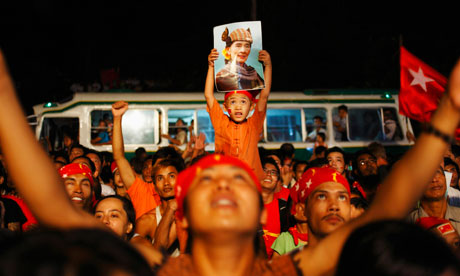
Aung San Suu Kyi wins seat in Burma's parliament
The victory, if confirmed, would mark a major milestone in the Southeast Asian country, where the military has ruled almost exclusively for a half-century and where the government is now seeking legitimacy and a lifting of Western sanctions.
The victory claim was displayed on a digital signboard above the opposition National League for Democracy's headquarters in Burma's main city, Rangoon.
Earlier, the party said in unofficial figures that Suu Kyi was ahead with 65 per cent of the vote in 82 of her constituency's 129 polling stations.
U.S. Secretary of State Hillary Rodham Clinton congratulated Myanmar for holding the poll. Speaking at a news conference in Istanbul, Turkey, she said Washington was committed to supporting the nation's reform effort.
"Even the most repressive regimes can reform, and even the most closed societies can open," she said.
Sunday's byelections, to fill a few dozen vacant seats in the country's legislature, followed months of surprising reforms by a nominally civilian government that does not relish ceding ground to Suu Kyi. But the leaders of Burma, also known as Myanmar, are making a push to appear more democratic in order to emerge from decades of international isolation that have crippled the economy.
Suu Kyi's party and its opposition allies will have almost no sway even if they win all the seats they are contesting, because the 664-seat parliament will remain dominated by the military and the military-backed ruling party. But when she takes office, it will symbolize a giant leap toward national reconciliation after nearly a quarter-century in which she spent most of her time under house arrest.
The 66-year-old Nobel Peace Prize laureate was vying to represent the constituency of Wah Thin Kha, one of dozens of dirt-poor villages south of Rangoon. She is running against the ruling party's Soe Win, a former army doctor.
'Psycho-social' victory for Burmese voters
Burmese democracy activist Maung Zarni, who is also a research fellow with the London School of Economics, cautions that Suu Kyi's victory would only be symbolic. He said even if her party won all of its seats, it would only represent eight per cent of the total seats in parliament.
"Politics is a numbers game. She is not likely to have much leverage, politically speaking, with the military junta," Zarni told CBC News on Sunday from a secret location in a neighbouring country. "At the end of the day, who calls the shot is the military."
Zarni said, for him, the biggest triumph was to see Burmese coming out to the polls to vote for Suu Kyi's party, calling it a "psycho-social" victory for his people who have remained cowed under an oppressive military regime.
Meanwhile, Suu Kyi's National League for Democracy party alleged Sunday that "rampant irregularities" had taken place on voting day.
Party spokesman Nyan Win said that by midday alone, the party had filed more than 50 complaints to the Election Commission. He said most alleged violations concerned waxed ballot papers that made it difficult to mark votes. There were also ballot cards that lacked the Election Commission's seal, which would render them invalid.
Push for reform
Last year, Burma's long-entrenched military junta handed power to a civilian government dominated by retired officers that skeptics decried as a proxy for continued military rule. But the new rulers — who came to power in a 2010 vote that critics say was neither free nor fair — have surprised the world with a wave of reform.
The government of President Thein Sein, himself a retired lieutenant-general, has freed political prisoners, signed truces with rebel groups and opened a direct dialogue with Suu Kyi, who wields enough moral authority to greatly influence the Burma policy of the United States and other powers.
Her decision to endorse Thein Sein's reforms so far and run in the election was a great gamble. Once in parliament, she can seek to influence policy and challenge the government from within. But she also risks legitimizing a regime she has fought against for decades while gaining little true legislative power.
Sunday's poll marks the first foray into electoral politics by Suu Kyi's National League for Democracy party since winning a landslide election victory in 1990. The military annulled those results and kept Suu Kyi in detention for much of the next two decades. The party boycotted the 2010 vote, but in January the government amended key electoral laws, paving the way for a run in this weekend's ballot.
...Read more>>>
China Coup Rumors
Authorities closed 16 websites for spreading rumours of "military vehicles entering Beijing and something wrong going on in Beijing", the official Xinhua news agency said, citing the state Internet information office.
Police arrested six people, while the country's two most popular microblogs, run by Sina.com and Tencent, said they would stop users from posting comments to other people's posts until Tuesday.
The crackdown follows a surge in unsubstantiated online rumours about a coup led by security chief Zhou Yongkang, following the March dismissal of rising political star Bo Xilai.
Analysts say the political drama has exposed divisions in the ruling Communist Party as it prepares for a key leadership transition later this year.
Bo, removed as party chief of the southwestern metropolis of Chongqing after his former police chief fled to a US consulate and reportedly demanded political asylum, had been tipped to join the country's top echelons of power.
His downfall was only lightly covered by China's tightly controlled state media, opening the way for groundless rumours about a coup to spread on the Internet.
In another sign of the state's tight policing of the web -- known as the "Great Firewall" -- Xinhua said 1,065 people had been arrested since February 14 during an operation in Beijing to combat Internet crime.
More than 3,000 websites had also received warnings after police targeted the smuggling of firearms, drugs and toxic chemicals, and the sale of human organs and personal information online, Xinhua said.
In an editorial, the People's Daily, the mouthpiece of the Communist Party, pledged to punish those responsible for the "lies and speculation".
"Online rumours undermine the morale of the public and if out of control, they will seriously disturb the public order and affect social stability," said the newspaper, according to Xinhua.
China says it is stepping up efforts to "cleanse" cyberspace, in what many see as a restriction on web freedom in the country, where a vast censorship system blocks sites including Twitter, Facebook and YouTube.
The crackdown on the hugely popular microblogs -- China has more than 500 million Internet users -- drew swift condemnation online.
"Stopping web users from posting comments on microblogs is a serious attack on freedom of expression and will go down in the history books," said a user called Lawyer 80 on weibo.com.
Xinhua reported the website closures late Friday, naming some of the sites involved as meizhou.net, xn528.com and cndy.com.cn, saying they had been shut in accordance with laws for failing to stop the spread of rumours.
The six people arrested were held for "fabricating and spreading" rumours "particularly through microblogging posts", said Xinhua, citing the Beijing municipal bureau of public security.
Sina.com and Tencent had carried online chatter speculating about a coup and were "criticised and punished accordingly", a spokesman for the state Internet information office said.
The spokesman was quoted as saying by Xinhua that both sites had pledged to "strengthen the management".
"Rumours and illegal, harmful information spread via microblogs have had a negative social impact and the comments contain a large amount of harmful information," said a message on Tencent's website.
"From March 31, 8:00 am to April 3, 8:00 am, weibo's comment function will be temporarily suspended," said Sina, whose weibo service is China's most popular.
The huge rise of weibos, or microblogs, has proved a major challenge to the "Great Firewall" and censors had been scrambling in recent days to block all forms of search on the microblogs for terms linked to Bo.
...Read more>>>