Banner Line

On June 16,2013 Vietnamese police defrocked/tortured Khmer-Krom monk Ven. Ly Chanda of Prey Chop Temple in Lai Hoa, Vinh Chau, Soc Trang province. June 20,2013 Venerable Thach Thuol and Abbot Temple Lieu Ny of Ta Set temple (Soc Trang-Khleang province) defrocked and imprisoned in Prey Nokor (Saigon) city by the Viet authorities. In Phnor Dach (Cau Ngang) district, Preah Trapang/Tra Vinh) Khmer Krom prohibited from watching Cambodian TV signals.

HRW: Cambodia Ruling Party Orchestrated Vote Fraud

Human Rights Watch- New York - July 31,2013

Donors Should Demand Independent Investigation of Election Irregularities

People search for their names on lists at a polling station in Phnom Penh on July 28, 2013.

(New York) – The ruling Cambodian People’s Party (CPP) appears to have been involved in electoral fraud in Cambodia’s July 28, 2013 national elections, according to residents and ruling party officials interviewed by Human Rights Watch. All allegations of election fraud and other irregularities, including bias in the election machinery, should be promptly investigated by an independent commission.

The CPP-controlled National Election Commission (NEC) released preliminary results showing that the ruling party won 68 seats and the opposition Cambodian National Reconciliation Party (CNRP) won 55. Based on the same results, the CPP won approximately 49 percent of the national vote, while the CNRP won approximately 44 percent. The opposition has claimed widespread fraud and called for the creation of an independent expert body that includes the United Nations and nongovernmental groups to examine the results and address irregularities.

“Senior ruling party officials appear to have been involved in issuing fake election documents and fraudulently registering voters in multiple provinces,” said Brad Adams, Asia director. “And people from the party seem to have been turning up in places where they clearly don’t live and insisting on voting – not to mention the many other claims of fraud around the country.”

A CPP village chief, who asked for anonymity to protect his security, gave Human Rights Watch an insider’s account of how ruling party authorities in his district engaged in electoral fraud by issuing fraudulent “Identity Certificates for Elections” (ICE) before the July 28 elections. The certificates allow people whose names appear on voter registration lists to vote even though they otherwise lack proper identification documents.

The village chief, whose local CPP superiors worked under instructions from a CPP Center-Level Work Team headed by an army general and a CPP Central Committee member, told Human Rights Watch that his immediate party superiors directly oversaw the illegal issuance of certificates. He explained that a member of the general’s team gave the instructions to issue certificates in the names of villagers who were on the voter registration rolls but were known either to be dead or to have long left their original homes.

The work team member allegedly arranged for soldiers and their wives from an army division stationed in the province to be photographed for certificates. These were then issued by CPP commune and Interior Ministry officials, who allegedly conspired in the scheme to falsely certify these soldiers and their wives as local residents eligible to vote in the commune where these officials were responsible for voter registration. One media report, which is consistent with other accounts, recounted villager descriptions of army-organized voting by thousands of soldiers shipped across provincial boundaries in military vehicles to vote in parts of Siem Reap province where none of them had ever been seen before.

“Issuing hundreds of thousands of fake identity certificates was allegedly one of several key ways the ruling party organized large scale election fraud,” Adams said. “Now, a CPP village chief has confirmed that this happened in his area.”

In another case, villagers in Kandal province, adjacent to the capital, Phnom Penh, described to Human Rights Watch efforts by senior CPP officials to vote in more than one place. When confronted by local residents, the party officials threatened them with arrest and later returned and made death threats.

Numerous residents of Koki Thom commune in Kandal interviewed by Human Rights Watch said that on election day, Ngo Sovan, whose business card states that he is “minister delegate attached to the prime minister” and specifies that he is a secretary of state at the Ministry of Justice, arrived in their commune to vote. He was accompanied by other members of the party’s grassroots strengthening team assigned to the area, as well as by Heng Seksa, whose card says he is a “deputy secretary-general of the Royal Cambodian Government,” and an entourage of dozens of government officials from Phnom Penh.

The villagers protested the group’s attempt to vote there, asserting to local electoral authorities that none of the people were local residents. The local electoral authorities, whom the villagers described as linked to the ruling party, nevertheless allowed the group to cast ballots.

Ngo Sovan’s team included several national level civil servants. According to the national voter registration list compiled from official data on the National Election Committee website and examined by Human Rights Watch, Ngo Sovan was registered to vote in three places. The first (voter registration number R-1424108) is at his known residence in Phnom Penh, where he is a prominent figure and resident, according to local residents Human Rights Watch interviewed.

Ngo Sovan is also registered in the provinces of Kandal (voter registration number R-6132454) and Svay Rieng (voter registration number R-6851267). He heads ruling party election grassroots strengthening or work teams in both provinces. In Kandal, Ngo Sovan also ran as a CPP candidate for the National Assembly.

Heng Seksa, who accompanied Ngo Sovan in Kandal, was registered to vote in both Phnom Penh (voter registration number R-6354916) and Kandal (voter registration number R-6132299), according to official data from the NEC website.

Villagers told Human Rights Watch that members of the entourage threatened them with arrest during the confrontation over whether the group’s members would be allowed to vote. After polls closed, a contingent of “flying tiger” motorcycle police arrived in the area. Villagers told Human Rights Watch that the police said they were looking for “ringleaders” of the “disturbances” that had occurred when the ruling party group’s voter registration was challenged.

The morning after the elections, some members of the group reappeared in the village along with others, including one armed man in civilian clothes, who attempted to identify and apprehend an alleged “ringleader.” Two witnesses told Human Rights Watch that members of the group threatened to kill villagers who refused to provide information on the whereabouts of the alleged ringleader, whom the group also vowed to kill and who has gone into hiding.

“The multiple voting scheme suggests the possibility of systematic election fraud by the CPP and raises serious questions about the credibility of the election,” Adams said. “Since the National Election Committee and local election commissions are under the ruling party’s control, influential governments and donors should demand independent investigations into these and other credible allegations of election related irregularities. Without this, it’s hard to see how Cambodian voters can have confidence in the legitimacy of the elections and the new government that results.”
...Read more>>>

Cambodia Election - Feeling Cheated

The Economist - Jul 29th 2013, 10:55 by L.H. | PHNOM PENH

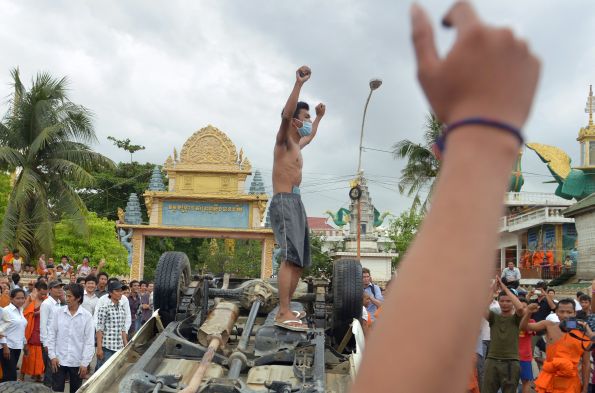
Voters Protest on Election Day July 28,2013

NOT long after the prime minister, Hun Sen, cast his vote at a teacher’s college on July 28th, the first signs of trouble emerged. Allegations that the electoral roll had been rigged were coming in from across Cambodia and a riot was about to erupt on the outskirts of the capital, Phnom Penh. The counting made it plain that Hun Sen and his Cambodian People’s Party (CPP) had won, and by a generous margin. But the opposition made substantial gains—as well as claims that the CPP had cheated.

It was a dramatic conclusion to a dramatic home stretch. On July 12th the government had issued a pardon to Sam Rainsy, an opposition leader who had exiled himself from Cambodia since 2009, while criminal charges were prepared against him. He made his homecoming on July 19th, when he was met by a jubilant crowd. They may have hoped that Mr Sam Rainsy’s presence could bring their party an outright victory in the polls, but he seemed to have known better. Even then, with a week to go before the election, he was threatening to have the results condemned if the rules weren’t changed.

When July 28th came round, some voters were angered to discover that their names were not on the rolls, or that other people had already voted under their names. Other rumours flew furiously: for instance that the CPP was shipping in Vietnamese from across the border to cast ballots.

“Khmer can’t vote—yuon can,” went up the cry on social-media sites and among many who were protesting against the CPP. Yuon means Vietnamese people in Khmer, the main language of Cambodia. Many regard it as a highly derogatory term. Two police vehicles were overturned and set alight. By nightfall troops were deployed, roads blocked and Phnom Penh’s lively rumour mill had gone into overdrive. It all made a tense atmosphere tenser.

By the end of preliminary counting, the CPP acknowledged that the Cambodian National Rescue Party (CNRP) led by Mr Sam Rainsy had picked up 55 seats, an impressive improvement on the 29 seats it had already held in the 123-seat parliament. The CPP won 68 seats for itself, down from 90, and so lost the two-thirds majority which had enabled it to rewrite the constitution. Minor parties, including the once-formidable royalist Funcinpec party, were obliterated.

Mr Sam Rainsy stayed true to form. Throughout the campaign he stoked popular anti-Vietnamese sentiment, and with it a familiar fear of hegemony on the part of Cambodia’s big neighbour to the east. Mr Sam Rainsy’s critics in Cambodia say his rhetoric verged on being xenophobic. The Vietnamese embassy issued a rare statement that accused him of using racially charged rhetoric to score political points.

That is even more a shame for the fact that he probably didn’t need it. This election was decided on more practical issues. The opposition’s greatest advantage was the anger that has been mounting against the massive land concessions that are granted to Chinese and Vietnamese companies; a widening wealth disparity; and gross corruption that favours the politically connected.

These issues were made more potent by the emergence of a powerful youth vote. Demographic change has altered the political landscape; those born as Cambodia’s civil wars were ending two decades ago are just now coming of age. Being too young to remember the 1980s and ’90s themselves, they tend to be unmoved by Mr Hun Sen’s main argument: that an opposition victory could spell a return to civil conflict.

Armed with smartphones and social media, the youth went to the barricades for the CNRP. This made for an especially lively campaign, and in turn diminished the relevance of the government-friendly media. Its propaganda machine, in the end, was capable of little more than preaching to the choir.

The opposition has rejected the results formally and demanded that an independent committee be set up to investigate the irregularities and their impact on the poll. One day after the polls closed, independent election monitors said it was too early in the counting process to determine whether the vote was free and fair. The Committee for Free and Fair Elections in Cambodia (Comfrel) noted some worrying irregularities, including the use of ink that was supposed to be indelible—to prevent people from voting more than once—but in fact washed off easily. Comfrel also noted the disappearance of some names from the voter lists prepared by the National Election Committee, and the fact that strangers were spotted loitering about some polling booths.

Mr Sam Rainsy told a hastily arranged press conference that the opposition was not trying to bargain its way into government. “What we are interested in,” he said, “is to render justice to the Cambodian people.”

Meanwhile Mr Hun Sen, who over 28 years has established himself as the longest-serving elected leader in South-East Asia, was staying tight-lipped. He has been handed a stark choice: Reform the CPP, or dig in his heels. Any real reform would have to include laying down a clear path for succession. If he insists on maintaining the status quo then civil unrest is almost certain, whatever may be said about future elections.

(Picture credit: AFP)
...Read more>>>

Refugee laws ignored: report

Source: Phnom Penh Post July 1,2013

Cambodian government officials have done little to enforce laws meant to protect the rights of Kampuchea Krom refugees, a recent report compiled for the UN says.

The five-page report, written by the Unrepresented Nations and Peoples Organization (UNPO), will be submitted to the United Nations Office of the High Commissioner for Human Rights ahead of its 2014 periodic review of Cambodia and Vietnam.

“In the areas of civil and political rights enough mechanisms are in place to adequately guarantee the rights of minorities, however, the implementation thereof is severely lacking,” the report says. “It takes political will from the Cambodian government.”

Despite the Cambodian government’s official stance that those who live in Kampuchea Krom – an area of southern Vietnam that was once part of the Khmer empire – are considered Cambodian nationals, they face discrimination and difficulties when trying to claim refugee status or obtaining identity cards in Cambodia, the report states. When applying for ID cards, applicants must show proof their parents are of Khmer ancestry, proof of their occupation and a permanent address – documentation people fleeing discrimination in Vietnam rarely possess.

“They didn’t have the rights that other Cambodian citizens have,” said Denise Coghlan, Cambodia country manager for Jesuit Refugee Services, an Australian Catholic NGO that focuses on refugee rights. The exact legal status for Khmer Krom remains fuzzy, she said.

The Cambodian constitution guarantees religious freedom in the Kingdom, but the UNPO report notes Khmer Krom Buddhist monks suffer systematic harassment and persecution in Vietnam and Cambodia. Khmer Kampuchea Krom have been detained, tortured and had their freedoms of speech and assembly trampled upon, the report notes.

About 200 people gathered in Phnom Penh last week to demand the release of two Khmer Krom monks Liv Ny and Thach Thoeun, both 30, who were arrested by Vietnamese authorities on charges they associated with pro-Khmer Krom organisations abroad.

UNPO’s report mentioned that although protections guaranteed by the constitution are often ignored by authorities, their existence is a step in the right direction.

“Despite widespread violations of human rights inflicted upon members of the Khmer Krom and Degar [montagnard] minorities, the government of Cambodia should be commended for incorporating key human rights . . . in their national constitution,” the report notes.

In order to improve its human rights standing for minorities, Cambodia should simplify the process in which Khmer Krom refugees can apply for ID cards, commit to investigating allegations of abuses by law enforcement among other steps toward inclusiveness.

The Cambodian government’s Human Rights adviser, Om Yentieng, declined to comment yesterday.
...Read more>>>

Smith Human Rights Bill on Vietnam Passed by Foreign Affairs Committee

Rep. Chris Smith (R-NJ) News Release

June 28, 2013 (Menafn - Congressional Documents and Publications/ContentWorks via COMTEX) --Washington, Jun 27 - Legislation on human rights issues in Vietnam was passed by the House Foreign Affairs Committee, said Rep. Chris Smith (NJ-04) author of the legislation, the Vietnam Human Rights Act of 2013.

The bill was approved in a unanimous voice vote of the full Committee.

Smith's Vietnam bill, H.R. 1897, would institute measures to improve human rights in Vietnam by prohibiting any increase in non-humanitarian assistance to the Government of Vietnam above Fiscal Year 2012 levels unless the government makes substantial progress in establishing a democracy and promoting human rights. The bill aims for improvement in freedom of religion (and releasing all religious prisoners), rights to freedom of expression, assembly and association, the release of all political prisoners, independent journalists, and labor activists, and to end any government complicity in human trafficking.

"Brazen human rights violations by the hands of the Vietnamese Government continue against its own people," Smith said, noting an April 11 congressional hearing that detailed widespread abuses, as well as government officials' involvement in trafficking Vietnamese women to Russia, Jordan and other locations. "The powerful testimony before Congress showed widespread religious, political and ethnic human rights abuse, and that Vietnamese Government officials are complicit in human trafficking. Vietnam, in fact, continues to be among the worst violators of religious freedom in the world," Smith said, noting the rights and freedoms of Buddhists, Catholics, Protestants and other faiths are routinely trampled upon by the government.

Go to: http://chrissmith.house.gov/news/documentsingle.aspx?DocumentID=328489 for information about the April hearing, or go to: http://foreignaffairs.house.gov/hearing/subcommittee-hearing-highlighting-vietnamese-government-human-rights-violations-advance-us to view Smith's opening remarks at the hearing or witnesses' testimony. Smith's bill was subsequently passed by the House global human rights panel, the Subcommittee on Africa, Global Health, Global Human Rights, and International Organizations, which Smith chairs, on May 15.

Read this original document at: http://chrissmith.house.gov/news/documentsingle.aspx?DocumentID=340844

Copyright (C) 2013 Federal Information & News Dispatch, Inc.
...Read more>>>

UNPO Exposes Human Rights Abuses in Cambodia and Viet Nam

UNPO has submitted reports to the United Nations High Commissioner for Human Rights in anticipation of the Universal Periodic Review of the Kingdom of Cambodia and Socialist Republic of Viet Nam. These reports focus shed light on the marginalisation of the Khmer-Kampuchea Krom, Hmong and Degar-Montagnards.

The United Nations (UN) Universal Periodic Review is a mechanism which assess UN member countries’ human rights performance. Every four and a half years the situation of human rights within a state is assessed, and both Cambodia and Viet Nam are up for review at the 18th session in early 2014.

Despite the difference in countries, there is some overlap in the human rights issues. Specifically, in neither country has the indigenous status of any member been recognised, nor does either country possess an effective mechanism for processing land claims, and land-grabbing and dispossession and common practices. Moreover, religious persecution exists both in Cambodia and Viet Nam, and it has been associated with abuse by law enforcement officers, arbitrary arrests, indefinite detentions, extrajudicial torture, and the forced defrocking of monks.

Furthermore, in Viet Nam traditional Khmer names (of people, villages, districts and provinces) must be substituted with Vietnamese names, and the Khmer language is considered illegal under the constitution. Vietnamese authorities further repress the Khmer by censoring Khmer activist websites, and cultural and religious television broadcasts from abroad. Education in indigenous languages is also prohibited in most schools, and when allowed, textbooks are poorly written and ridden with mistakes. Imported textbooks are banned.

In Cambodia, the government bureaucracy makes it nearly impossible for Khmer Krom or Degar-Montagnard asylum seekers to be granted refugee status or identification cards. The requirement of unrealistic criteria (such as a permanent address in Cambodia) effectively prohibits the acquisition of such statuses. And when the refugees are able to satisfy the stringent criteria, often the authorities illegally force Khmer Krom to adopt a Cambodian name and perjure their place of birth to Cambodia. Additionally, the Cambodian state has pressured a refugee centre operated by the UN to shut down, decreasing transparency in how Cambodia deals with refugees.

UNPO’s reports make a series of recommendations to the HRC, including to:
[Viet Nam & Cambodia] Formally acknowledge and confirm the indigenous status of the Khmer Kampuchea Krom peoples, as well as that of the Christian Degar Montagnards;

[Viet Nam & Cambodia] Create an effective mechanism for the settlement of outstanding land claims by indigenous groups, and compensate those groups for the loss of their ancestral lands, as stipulated by Article 8 of the Universal Declaration on the Rights of Indigenous Peoples;

[Viet Nam & Cambodia] Commit to investigating widespread allegations of abuse by law enforcement, arbitrary arrests, and extrajudicial torture, and explore possible judicial remedies for victims and their families.

[Viet Nam & Cambodia] Sign and ratify International Labour Organization Convention 169 concerning Indigenous and Tribal Peoples in Independent Countries, with the aim of respecting the traditions of indigenous peoples in relation to the use of their ancestral lands;

[Viet Nam] Amend domestic law provisions that criminalizes certain religious activities on the basis of vaguely-defined crimes of national security

[Viet Nam] Permit outside experts, including those from the United Nations and independent international human rights organizations, to have access to indigenous and minority communities in Vietnam;

[Cambodia] Afford refugee status, and the protections it entails, to all individuals, including Khmer Krom and Degar individuals, who satisfy the internationally accepted definition of a refugee. This includes ceasing the forced repatriations of Degar and Khmer Krom asylum seekers;

[Cambodia] Clarify the situation regarding the granting of citizenship to Khmer Krom individuals with authorising offices and officers, including what evidence is needed and what practices are not to be tolerated.


Source: http://www.unpo.org/article/16105
...Read more>>>

Access submits UPR report on Vietnam: Cyber attacks on civil society a key concern

3:57pm | 19 June 2013 | by Connor Gadek
Deborah Brown contributed to this post


Access has partnered with ARTICLE 19, PEN International, and English PEN on a joint submission on Vietnam to the United Nations Universal Periodic Review (UPR). The submission focuses on the lack of improvement of human rights, specifically freedom of expression, in Vietnam since the last UPR in 2009, and highlights the Vietnamese government’s troubling response to the recent increase in cyber attacks against civil society.

The UPR was established in 2006 by the UN General Assembly to ensure the “fulfilment by each State of its human rights obligations.” The UPR is a mechanism to review the human rights record of all UN Member States and make recommendations for improvement every 4.5 years. Vietnam’s next review – when Access’ UPR submission will be taken into account – is scheduled for January 2014.

The submission notes that considerable limitations on free expression in Vietnam remain despite the fact that the Vietnamese government accepted a recommendation from the government of Sweden during its last review to “ensure that full respect for the freedom of expression, including on the Internet, is implemented.” Of particular concern is state controlled media and the lack of press freedom, restrictive legislation on freedom of expression, internet surveillance and cyber attacks on civil society, and the persecution of writers, journalists, bloggers, and human rights defenders.

Cyber Attacks

In the second cycle, we highlight the fact that cyber attacks on civil society in Vietnam have recently escalated to include: Denial-of-Service (DoS) attacks, fake domains, account takeovers, and website defacement. The impact of these attacks extend far beyond those directly targeted. The attacks broadly infringe upon civil society’s freedom of association, freedom of expression, and right to access information which are established by the International Covenant on Civil and Political Rights, to which Vietnam is party.

The report notes that pro-government actors in Vietnam have used DoS attacks to make independent media websites unavailable by falsely overloading the sites with internet traffic until they crash. The DoS attacks target websites that are either critical of the government or offer a platform for activists to organize, such as Facebook which is often inaccessible to many in Vietnam for varying lengths of time.

In Vietnam, pro-government actors have utilized fake domains to mirror the exact information of independent media websites while serving malware to their web visitors. The malware is used to implement key-loggers onto the visitor’s computer in order to access their private account information.

In addition, civil society organizations and activists in Vietnam have been subject to account takeovers. This is often accomplished through the use of malware-laden fake domains which breach an internet user’s digital security to access their private account information. On 26 May 2013, the government arrested Vietnamese blogger Truong Duy Nhat and his website was immediately compromised. Just after his arrest, visitors to his website would receive malware downloaded and installed onto their computers without the website visitor’s knowledge.

Website defacement has also been used in Vietnam as a tactic to suppress speech by changing the content of independent media websites’ to promote alternative views to the original content. These attacks are meant to delegitimize independent media and hinder activists’ ability to peacefully organize against government policies.

Recommendations

The UPR submission makes several important recommendations to the Vietnamese government on how to improve its treatment of digital rights and free expression. These include allowing online anonymity, allowing internet users to access blogs and websites outside of Vietnam, ending arbitrary surveillance of internet users, and ending any use of cyber attacks.

The review also requests that the Vietnamese government allow UN human rights experts, known as special rapporteurs, on the promotion and protection of the right to freedom of opinion and expression, on the rights to freedom of peaceful assembly and of association, and on the situation of human rights defenders to visit and evaluate the current situation in Vietnam.

The UPR is the first mechanism put in place by the UN to address all human rights issues in all countries. This process is one of the few ways for NGOs to work with governments to improve human rights and hold them accountable to international law. Access is concerned by the ongoing violations of freedom of expression in Vietnam and the specific targeting of Vietnamese civil society, who use the internet to exercise their fundamental rights. We view Vietnam’s UPR as a valuable opportunity to engage the government on the global stage and to raise international pressure on Vietnam to protect and promote human rights, both online and off.
...Read more>>>

Vietcongs police arrest anti-government blogger

HANOI | Fri Jun 14, 2013 5:06am EDT

Blogger Pham Viet Dao
(Reuters) - Vietnamese police have arrested an author and blogger for posting anti-government comments online, according to authorities, the latest in a crackdown on critics of the country's Communist rulers.

Pham Viet Dao, 61, was arrested on Thursday at his Hanoi home and accused of breaching a law prohibiting "abuse of democratic freedom" and "infringements against the state", according to the Ministry of Public Security.

If the case goes to trial and Dao is found guilty, he could face seven years in prison.

Dao has long been critical of Vietnam's one-party system. Like other bloggers bold enough to test the limits of Vietnam's constitutionally enshrined free speech, Dao has gained notoriety as internet usage grows and discontent simmers over the government's handling of a stale economy and rampant graft.

His arrest follows that of former journalist Truong Duy Nhat on May 26, who was also held under the same law.

The authorities have taken a harsh line on dissent, with arrests and convictions on the rise in the past three years and bloggers increasingly targeted as the number of web users soars to a third of Vietnam's estimated 90 million people.

The United States is keen to boost trade with Vietnam but has urged improvements in its human rights record as a prerequisite before strengthening defense and diplomatic ties.

In a June 5 address to Congress, the U.S. State Department's envoy for democracy, Daniel Baer, described Vietnam's crackdown on bloggers as part of "a years-long trend of deterioration".

(Compiled by Hanoi Newsroom; Editing by Robert Birsel)
...Read more>>>

Vietnam’s Prime Minister Slammed in Rare Confidence Vote

RFA - June 11,2013

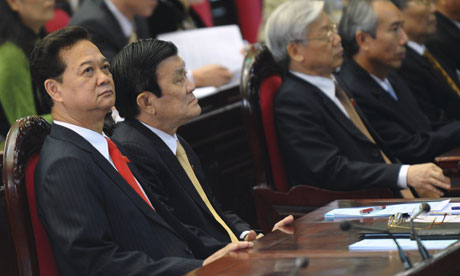
Nguyen Tan Dung (L), Nguyen Phu Trong (C), Truong Tan Sang (R) in Hanoi, May 20, 2013.
Nearly one-third of Vietnam’s lawmakers have expressed dissatisfaction with Prime Minister Nguyen Tan Dung’s performance in the first ever confidence vote, state media reported Tuesday, amid reports of a power struggle within the leadership of the ruling communist party.

Several Vietnamese citizens told RFA’s Vietnamese Service that the vote was a sham, intended to cover up the government’s weaknesses and criticism over accountability, and reflected infighting within the administration.

Dung and 46 other top-ranking ministers and officials faced a vote of “high confidence,” “confidence,” or “low confidence” by secret ballot from the 498-member National Assembly, the country’s rubber stamp parliament, according to the official Vietnam News Agency.

Dung received more than 160 negative votes, representing more than 32 percent of assembly members—the third worst rating received by an official in the rare display of scrutiny.

President Truong Tan Sang, who is seen as the main political opponent to Dung, received only 28 negative votes. He also received the third highest number of “high confidence” votes compared to Dung’s rank of 25th.

Dung’s poor rating follows his admission last October that he had failed to effectively lead Vietnam’s economy out of turmoil just one week after he effectively escaped a leadership change at a crucial ruling Communist Party central committee meeting where he was publicly rebuked over a string of scandals that were traced back to the country’s leadership.

The vote provides a rare glimpse into how Sang’s popularity has grown while Dung struggles through his second term as prime minister, which will end in 2016.

Reports have said that the party is split between factions aligned with either the president or the prime minister.

The highest number of negative votes went to Nguyen Van Binh, Vietnam’s central bank governor, who received 209. The country’s education minister, Pham Vu Luan, was given 177 low confidence votes. The economy and the poor standard of schooling are the two highest items on the list of public concerns.

No officials received a rating of low confidence from two-thirds of the assembly which, according to ballot rules, could lead to their forced resignation.

The ballot also lacked a “no confidence” option for voters from the legislative body, where more than 90 percent of lawmakers are card-carrying members of the Communist Party.

The Vietnam News Agency quoted Assembly Chairman Nguyen Sinh Hung as praising the vote, saying it “reflected exactly the current situation of the country, covering all aspects from society, foreign policy to national defence, security and justice.”

Official infighting

But sources told RFA’s Vietnamese Service that the general public considered the vote an indication of political infighting at the top levels of leadership, and otherwise offered no solution to the country’s problems.

“I think they are preparing for some kind of internal conflict and that the people don’t care about the vote,” said journalist Truong Minh Duc.

“The people do not participate in the National Assembly, so this is just for internal purposes … This is a vote by the Communist Party representatives, not by the people.”

Architect Tran Thanh Van, a prominent intellectual in Hanoi, called for a reevaluation of the system that places officials in positions of power so that the people are better represented.

“The issues of the voting system, how officials stand for election, and for the selection of candidates and representatives need to be addressed,” he said.

“The lawmakers need to be elected by the people before any votes take place within the National Assembly.”

A teacher named Pham Toan, called the vote “a mere joke” that failed to take the public sentiment into account.

“Why is the vote of confidence conducted by lawmakers that the people don’t have any confidence in,” Toan asked.

“The vote should have been taken by representatives that the people trust.”

Other sources complained that the government had provided no clear explanation of how it would deal with officials who received low confidence ratings.

‘Voiceless people’

In addition to its failure to right an ailing economy and education system, the Communist Party has faced criticism in January for proposing a constitutional revision widely seen as undemocratic.

Vietnamese authorities have also come under fire from human rights groups and some Western governments for jailing and harassing dozens of activists, bloggers, and citizen journalists since stepping up a crackdown on protests and freedom of expression online in recent years.

A female farmer who has repeatedly petitioned the government over losing her land without any resolution said that many Vietnamese had given up hope of having any say in their political future.

“We people at the bottom don’t know what is what. All we can do is hope that those at the top vote with our best interests in mind,” she said, speaking to RFA on condition of anonymity.

“We voiceless people can’t do anything.”

Reported by Viet Long for RFA’s Vietnamese Service. Translated by Viet Long. Written in English by Joshua Lipes.
...Read more>>>

Vietnamese Activists Form 'Brotherhood for Democracy'

Reported by An Nguyen for RFA's Vietnamese Service. Written in English by Parameswaran Ponnudurai and Joshua Lipes.

A group of mostly former jailed dissidents in Vietnam have set up a new online group to coordinate efforts to bring democracy to the country, now under one party communist rule.

The movement, known as the "Brotherhood for Democracy," was established about 10 days ago and the membership has grown to 70 so far.

The group wants to move away from what it calls individual- and petition-based approaches that have been taken so far to highlight the need to bring freedom to the country, organizers said.

"It is time for domestic democracy activists to gather to discuss and find the shortest path for democracy in Vietnam," lawyer Nguyen Van Dai, a former dissident prisoner and co-founder of the group, told RFA's Vietnamese Service.

"Before this, [pro-democracy] movements in Vietnam were just individual-based," he said. "There was no coordination. That was why they were weak."

"Now with the Brotherhood for Democracy, we can maximize the strong points of each individual, creating collective strength to fight more vigorously and, at the same time, help one another to overcome weak points. This helps to create a solidarity between us."

Bloc 8406

The biggest online Vietnamese group pushing for democratic reforms is Bloc 8406. It was organized across the country in 2006, but many of its leaders, including co-founder Roman Catholic priest and dissident Nguyen Van Ly are languishing in prison.

Ly was involved in various pro-democracy movements, for which he was imprisoned for a total of almost 15 years. His support for Bloc 8406 led to his latest sentence on March 30, 2007, for an additional eight years in prison, where he was released and then jailed again in 2011.

Unlike the Bloc 8406, the Brotherhood for Democracy is largely based in northern Vietnam, observers say.

"The democracy movement in Vietnam has reached a very high level [of momentum]," said Pham Van Troi who was among the first to sign up for membership in the new group after emerging from prison recently following a four-year sentence in October 2009 for pro-democracy activism.

"Many people want to join the brotherhood or want to establish their own groups. They are activists who fight for human rights in Vietnam everyday … We only care for our universal goal and work together toward that goal," he told RFA.

Internet-based

Both Dai and Troi said there was no need to seek permission from the Vietnamese authorities to register the group and hoped the government will not harass the members over the move.

"We set up this association on the Internet," Troi said. "We use information technology to seek democracy for the Vietnamese. Vietnam law does not have any regulations related to this kind of online activity."

"And because we don’t have to ask permission from the government, we hope not to face any interrogations by the government."

Dai said Vietnamese law, under Article 69, allowed for freedom to form an association of expression.

Online interaction

He said Brotherhood for Democracy would evolve based on online interaction through social utility groups like Facebook.

"We created a connection between us without being controlled by the law of Vietnam and we don' t need to ask for permission. We only have to adhere to the rules set by Facebook, service providers, U.S. law and international law," he said.

"Our law does not prohibit that activity. Everybody can meet on the Internet and when we see one another in real life, we also do not need to have any permission."

Dai also made clear that the Brotherhood for Democracy was not intended to stifle the growth of pro-democracy groups.

"If there are only a few associations or political groups, there is no way to force a big change in Vietnam. At the moment, we need many associations and groups to develop in different areas, including people from all walks of life, so in the future they can be big and strong enough to create a coalition, a bigger organization," he explained.

"By that time we can pressure the government to make changes to the pave the way for democracy, bringing benefits to all Vietnamese people in Vietnam."
...Read more>>>

Communist Vietnam -- Human Trafficker Extraordinaire

By Michael Benge, AmericanThinker, May 4,2013

Vietnam is now the proud possessor of the inglorious title "The Worst Human Rights Violator in Southeast Asia," according to recent testimony before the House Committee on Foreign Affairs. State-affiliated labor export companies are major suppliers of men, women, and children to the forced labor and sex trafficking markets, while government officials profit from kickbacks.

Statistics on Vietnam's human trafficking range widely; though accurate information about this communist country is hard to find. Vietnam's Ministry of Public Security offers an official figure of 2,935 Vietnamese who were subjected to human trafficking between 2004 and 2009. However, international organizations report a far larger number; more than 400,000 victims since 1990. Even this covers only those reported as victims, omitting untold tens of thousands of abuses that go unnoticed, especially in the labor force.

Exporting workers is nothing new for Vietnam. After the 1975 communist takeover, hundreds of thousands of laborers were sent to the Soviet Union and European Eastern-Bloc countries as a form of war debt payment. Many ended up jobless, in debt, and stranded. Vietnam quickly graduated from supplying forced labor to trafficking women and children as sex slaves.

State-Sanctioned Sex Slavery

Vietnam is a primary supplier for commercial sexual exploitation, as well as forced labor -- and some who start out as laborers also wind up as sex slaves. Fraudulent or misrepresented marriages are one method by which Vietnamese women are exploited. The lure of marriage to a man in a comparatively rich country, coupled with a promised payment of up to $5,000 (ten times the average annual wage in Vietnam), is often too great a temptation for rural women and their impoverished families to resist. Women and children are sent to Cambodia, China, Laos, Thailand, Malaysia, Taiwan, Macau, the Middle East, and Europe. In turn, Cambodian children are trafficked to urban centers in Vietnam. Increasingly, Vietnam is a destination for child sex tourism, with perpetrators visiting from Japan, the Republic of Korea, China, Taiwan, the UK, Australia, Europe, and the U.S. Women are also shipped to other countries to serve as surrogate mothers. Some are forced to produce babies for families that cannot have their own, while others have their babies sold for adoption by foreigners, primarily from Western countries.

Russia: a Case in Point

Ms. Hui Danh recently testified about a sex-trafficking and extortion ring that lured young Vietnamese women to Russia with promises of high-paying jobs (by Vietnamese standards) as waitresses. Instead they were sold to brothels in Moscow. The operation was run by government-sanctioned labor agencies, which provided kickbacks to Vietnamese officials. The passports of the young women were confiscated; they received only a pittance in pay, and had no health care or any way to return home. Some girls were held captive in Russia for more than four years, and were savagely beaten if they tried to leave the brothel. Even though they were being held against their will, they still had to pay rent and were charged for their meager food and clothing.

Ms. Danh's younger sister Be Huong was one of the sex slaves. After several months, her impoverished parents received a call asking for money to pay for medical expenses. They scraped together $300 and sent it to her. A few weeks later she called again saying that the employment agency in Vietnam had agreed to let her return home, but she would need $2,000 for air travel. Ms. Dang, who was living in the U.S., borrowed the money and sent it to the employment agency. Soon the amount was raised to $4,000, and later to $6,000; clearly, it was extortion.

In February of this year, 13 months after her enslavement, Be Huong escaped from the brothel, along with three other victims. She was able to contact the Consular Envoy, Nguyen Dong Trieu, in the Vietnamese Embassy in Moscow and begged for his help. Trieu told her that prostitution was not legal in Russia and said, "Whoever brought you here, ask them to take you home." Two days later, Be Huong and the other three victims were recaptured by the brothel guards, and the three girls with her were severely beaten. Be Huong later learned that the Madame of the brothel in Moscow was a good friend of the Consular Envoy, who had betrayed the girls.
When Ms. Danh learned of her sister's plight, she contacted two U.S. non-government organizations; Boat People SOS, and the Coalition to Abolish Modern-Day Slavery in Asia, which put her in contact with Congressman Al Green and the State Department.

Through their efforts and with assistance from the media, Be Huong was returned to Vietnam, but not without costs. First, she was forced by the brothel Madame -- Thuy An -- to call her parents and ask them to withdraw their complaint to the Vietnamese police about the employment agency. Ms. Danh also had to submit a written apology to the Madame for wrongly accusing her of sex trafficking. Finally, she was also forced to write a letter to Vietnamese officials in Moscow thanking them for helping with Be Huong's repatriation. Only then was she allowed to leave.

Finally, Be Huong was allowed to go to the Vietnamese Embassy; there she was told by staff member Kien that her release was conditional. She had to write a letter stating what she had told her relatives about Madam Thuy An was inaccurate, and one thanking the embassy officials and Madam Thuy An for having helped her with repatriation.

The Vietnamese Embassy had of course done nothing, nor had Madam Thuy An, for it was only through diplomatic and media pressure that Be Huong was allowed to go home. Through continued pressure, six other victims were finally released and returned to Vietnam. Eight others remain enslaved by Madame Thuy An, with the assistance of the Vietnamese Embassy in Moscow.

Labor Trafficking

Vietnam started its labor trafficking by taking a page from the playbook of communist Field Marshal Tito, who exported surplus labor as a safety valve to reduce resistance amongst Yugoslavia's youth. Tito was an extreme and ruthless dictator (though quite popular in the West) who served as "President for Life" until his death in 1980.

Communist Vietnam now exports a great share of its labor force in an attempt to quell the unrest fermenting in that country, as well to increase revenue; in 2007, Vietnamese working in foreign countries sent home the equivalent of US $2 billion. Vietnam has a labor force of more than 51.4 million workers, and 70% of the population is under 30 years of age. Despite the labor trafficking, 12% -- 10 million -- of Vietnam's remaining workers are jobless, according to the International Monetary Fund.
The Vietnamese government set a goal to send 500,000 workers overseas in 2005, and the number has been increasing ever since. In 2008, Vietnam reached an agreement with Qatar to increase the number of workers to be sent to the Middle East from 10,000 to ten times that number by the end of 2010.

The Art of Trafficking

Many labor export companies in Vietnam are part of intricate trafficking syndicates and extortion rings, and government officials and banks are frequently involved. Applicants are deceived by contracts -- dubbed hop dong noi -- "domestic contract," that describe the type of work, good working conditions, and decent pay; however, they may have to pay as much as $10,000 just to apply. Applicants are often encouraged to seek a loan, such as one from a state-owned Agricultural and Rural Development Bank, to cover the fee, using their parents' property as collateral. If the loan is not enough, the parents have to mortgage or sell their remaining properties.

After the non-refundable application fee is paid, the workers are often given the real contract to sign only a day or so before leaving. This typically stipulates different terms than the original contract, using legal terms they cannot understand. Once in the destination country (which may not be the one they signed up for), the workers' passports and documents are confiscated and they are forced to sign yet another contract, hop dong ngoai -- "foreign contract," in a foreign language they cannot understand at all. Thus they find themselves working longer hours under substandard conditions, for much less pay than promised, with little or no access to medical care. Many times, workers are not fully paid and are held in debt bondage, while being forced to make mandatory monthly payments to the labor export company. As a result, workers cannot pay off their loans, have no money to return home, and their families lose their land and other properties.

The Vietnamese Embassies provide little or no help to these exploited people. True, the Vietnamese government has passed laws against human trafficking, and prosecutes a few cases now and then; but that is just window dressing. It's a charade to fool the UN, the U.S., and other gullible donor countries into believing that Vietnam's communist government is addressing the issue. Meanwhile, the labor and sex trade goes on with a wink and a nod from officials who are on the take. By the way, did you know it's against the law in Vietnam to report corruption?
...Read more>>>

US: Human rights worsening in China, Vietnam

April 20,2013

WASHINGTON (AP) — Human rights conditions are deteriorating in China and Vietnam but improving in Burma as it continues on its bumpy path to democracy, the U.S. said Friday.

The State Department also said in its annual assessment of human rights around the world that conditions in North Korea remain “deplorable.” The report said defectors reporting extrajudicial killings, disappearances, arbitrary detention, arrests of political prisoners and torture.

The department took aim at the continuing crackdown on political activists and public interest lawyers in China during 2012. It pointed to a “systemic” use of laws to silence dissent and punish individuals, and their relatives and associates, for attempting to exercise freedom of expression and assembly.

Authorities increased repression and restrictions on religious freedom in ethnic Tibet regions, where rising numbers of people have set themselves on fire to protest against Beijing, the report said.

The department’s conclusions typically draw a stiff response from the Chinese government, where the Communist Party monopolizes power but has overseen decades of rapid economic growth that has hoisted hundreds of millions out of poverty.

In Vietnam, another one-party state, the report said the government has attacked critical web sites and spied on, fined, arrested, and convicted dissident bloggers. The U.S. also criticized the imprisonment of dissidents using vague national security legislation, and restrictions on religious and labor rights.

The department said Burma “continued to take significant steps in a historic transition toward democracy” in 2012, with political prisoner releases, relaxing press censorship and allowing trade unions. It also staged by-elections that saw Nobel laureate Aung San Suu Kyi take a parliamentary seat.

But it said the country’s authoritarian structure from five decades of military rule remains largely intact.

Burma also needs to work urgently to overcome deep divisions that have caused outbreaks of inter-ethnic violence, claiming at least 100 lives and displacing tens of thousands in Rakhine State in June and October. Those bloody clashes — that have spread this year to the country’s heartland — have mostly targeted minority Muslims.

In Indonesia, which has transitioned from military rule to become one of Southeast Asia’s most robust democracies, the U.S. said security forces are reporting to civilian authority.

But suppression of the rights of religious and ethnic minorities is a problem, it said. The government applied treason and blasphemy laws to limit freedom of expression by peaceful independence advocates in the provinces of Papua, West Papua and Maluku, and by religious minority groups.

The report said the government of Sri Lanka tightened its grip on power and made little meaningful effort in 2012 toward reconciliation with the Tamil minority community following the end of the country’s long civil war four years ago. Involuntary disappearances continued and the government did not account for thousands who disappeared in prior years.

The U.S. also criticized the government’s impeachment of the Supreme Court chief justice, and said persons allegedly tied to the government attacked and harassed civil society activists, journalists and purported Tamil rebel sympathizers.
...Read more>>>

[Hmong] Vietnamese church leader killed in custody

Published: April 03, 2013--CathNews

Beaten picture of Vam Ngaij Vaj
A church leader has died in police custody in Vietnam, according to the rights organisation Christian Solidarity Worldwide (CSW), ucanews.com reports.

Photographs taken soon after the death of Vam Ngaij Vaj show “severe and bloody bruising” on his back and neck, CSW said in a statement on Tuesday.

“CSW calls on the Vietnamese government to fully investigate the circumstances in light of signs that he was tortured,” said the group’s chief executive, Mervyn Thomas.

Vaj, an elder of a church affiliated to the officially recognized Evangelical Church of Vietnam (South) and a member of the Hmong minority, was arrested for “destroying the forest” while clearing brush from his field with his wife, CSW said.

He was arrested on March 16 and died just a day later. Police claim he had accidentally put his hand into an electric socket, CSW said.

But the US Morningstar News website quoted a local Hmong leader as saying he may have been electrocuted as well as beaten.

The incident occurred in Dak Nong province in the Central Highlands and CSW said sources there report that the charge of destroying the forest is used to intimidate local Christians, many of whom fled to the area from further north to escape religious persecution.

It says it received reports last month of harassment and intimidation by local authorities and “thugs working with them.”

In another story, a Catholic Vietnamese fish farmer who became a hero for resisting compulsory land eviction has gone on trial, Radio Australia reports

Doan Van Vuon is charged with attempted murder after he and his family confronted authorities trying to evict them from their fish farm in Tien Lang district.

Mr Vuon, 50, is being tried for attempted murder with three other male relatives, who have all been in detention since the incident.

The charge carries a maximum sentence of death.

His wife and sister-in-law are being tried on a charge of resisting officers.

According to the indictment read out in court, Mr Vuon and his relatives used the homemade weapons and demonstrated "murderous behaviour" towards public officials.

"I knew the use of weapons was not in accordance with the law... my view was that the eviction was illegal so if they did not stop I would be forced to fight it," Mr Vuon said.

"We just wanted to threaten them."

He said his family did not intend to hurt anyone during the standoff but had decided to fight back to try to draw the attention of the country's leaders to their plight.

Five former local officials in the area will go on trial next Monday over the destruction of Mr Vuon's house.
...Read more>>>

Vietnamese Blogger’s Home Targeted with Rank Liquid

Huynh Ngoc Tuan
Source: RFA English April 8,2013

A prominent blogger said Monday that he and his family in central Vietnam have been victimized by what he believes to be agents hired by local security forces to threaten him over his online criticism against the state.

The once-imprisoned Huynh Ngoc Tuan, 50, told RFA’s Vietnamese Service that the attack occurred at 12:30 a.m. on April 4 when two assailants pulled up to his home in Quang Nam province on a motorbike and threw rank liquid near his bedroom.

“I heard the sound of a motorbike outside, which was nothing strange, but then I heard the sound of water splashing onto our steel gate … twice. Then I came out of my house because I knew something was going on,” Tuan said.

“In the light from the neighbor’s house I saw the backs of two young men. I saw that the water was thick and contained fish heads and organs, as well as some human excrement. It was overpowering,” he said.

Tuan said that he woke everyone in the house up and told his eldest daughter, Huynh Thuc Vy, to take pictures of the liquid.

“Thuc Vy ran out and when she smelled it, she threw up,” he said.

The family spent the entire night cleaning the house, Tuan said, but was unable to get rid of the stench.

“The neighbors smelled the liquid and asked what had happened and who had done it. I told them that it was probably the police that attacked our family … because they don’t like me, but have no legal basis to make me stop writing,” he said.

“We wrote essays and articles that they don’t like, so they attacked our family and harassed us … This is not the first time. They have done the same thing to other dissidents.”

Repeated harassment

Police have harassed the Huynh family at their home in Quang Nam in recent years since Tuan, a member of the government-banned Unified Buddhist Church of Vietnam (UBCV), and his eldest daughter Huynh Thuc Vy began receiving attention for their blogs.

Tuan is accused by local authorities of posting articles on the Internet which “oppose the Party and State.”

According to Paris-based Vietnam Committee on Human Rights (VCHR), security agents recently threw two venomous snakes into Thuc Vy’s home as a warning to stop her blogging activities as a political and social commentator.

More recently, the group said, local police pressured the landlord of Tuan’s younger daughter Huynh Khanh Vy to expel her from her lodgings in Danang just two weeks after she had given birth. Her request for a scholarship to study in Australia was also blocked.

Less than three weeks ago, Khanh Vy told RFA’s Vietnamese Service that she and her husband had been targeted for frequent residence permit checks and had lost job opportunities because of police intervention.

In 2011, police raided the Huynh family home in Tam Ky, confiscating their computers.

The next year, after Thuc Vy went to Ho Chi Minh City to take part in an anti-China demonstration, police took her into custody and drove her back to Quang Nam, in what she said was an attempt to scare her into avoiding future protests.

After Thuc Vy and her father Tuan were each awarded an international free speech prize last year, Huynh Trong Hieu, the brother, planned to travel to pick the awards up on their behalf, but was barred from leaving Vietnam and had his passport confiscated.

Khanh Vy, Thuc Vy, and Trong Hieu, who is also a blogger, are all in their twenties.

Tuan was arrested in 1992 and sentenced to 10 years in prison for “spreading propaganda” against the one-party communist state. He was released in 2002, but remained under house arrest for the next four years.

Police surveillance and harassment is a common experience for dissident bloggers in Vietnam, which is listed by press freedom watchdog Reporters Without Borders as an “Enemy of the Internet.”

Vietnamese authorities have jailed and harassed dozens of bloggers, citizen journalists, and activists over their online writings since stepping up a crackdown on freedom of expression in recent years.

Many have been jailed under Article 88 of the Vietnamese Criminal Code for “conducting propaganda against the state,” and international rights groups and press freedom watchdogs have accused Hanoi of using the vaguely worded provision to silence dissent.

Reported by RFA’s Vietnamese Service. Written in English by Joshua Lipes.
...Read more>>>

US: Vietnam backsliding on human rights

By By MATTHEW PENNINGTON, Associated Press
March 21,2013

WASHINGTON (AP) — The Obama administration expressed concern Thursday about Vietnam's "backsliding" on human rights and asserted that advancing individual freedoms is key to U.S. policy in Asia.

One example cited is Hanoi's treatment of bloggers who have faced prosecution under national security laws. Deputy Assistant Secretary of State Dan Baer told a congressional panel that Vietnam's authoritarian government is rightly proud of expanding Internet use, but it has diminished the value by curbing free exchange of ideas. Baer described those national security laws as draconian.

U.S. senators urged the administration to emphasize the promotion of human rights and democracy as part of its strategic pivot to Asia, which has primarily been cast as an attempt to increase America's military presence and boost trade in response to China's rise.

"What would set us apart from authoritarian competitors and would lay the groundwork for a truly American legacy in East Asia is a strong commitment to advancing individual freedoms," said Republican Sen. Marco Rubio.

Vietnam is one focus of Washington's outreach but Hanoi's poor human rights record has made that awkward. Vietnam began opening its economy in the late 1980s and wants to integrate with the world, but it remains a one-party state with strict controls on freedom of speech and political expression. Activists, including bloggers, are routinely arrested and imprisoned.

"The government needs to come around to seeing that the Internet penetration they are proud of isn't fully valuable without people being able to exchange ideas," said Baer, whose portfolio covers human rights, democracy and labor standards. He also noted that Vietnam's progress of a few years ago in religious freedom has stagnated.

There's been some brighter news. Hanoi freed American-Vietnamese democracy activist Nguyen Quoc Quan in January and U.S.-trained human rights lawyer Le Cong Dinh in February. That progress, however, has been overshadowed by recent convictions of dozens of other Vietnamese activists who have recent stiff jail terms.

Frustration over Vietnam's failure to improve its rights record prompted the U.S. to postpone an annual human rights dialogue that was due in late 2012. Officials tell The Associated Press the next dialogue has now been set, and will be held in Hanoi in mid-April.

Baer said the U.S. will "continue to make its case firmly" to Hanoi on various rights concerns, and will also raise Internet freedom and labor conditions in negotiations on the U.S.-backed Trans-Pacific Partnership, a regional trade pact that involves Vietnam.

Addressing the situation across the broader region, acting Assistant Secretary of State for East Asia Joe Yun asserted that advancing democracy and human rights "binds together" the Asia rebalance strategy.
He expressed deep concern about deteriorating human rights in China, and said the U.S. has told Beijing it regards its repatriation of refugees and asylum-seekers fleeing to China from North Korea as a violation of its international obligations.

On North Korea, which is reputed to hold up to 200,000 people in prison camps, Yun said that improving dire conditions there is an "essential goal" of U.S. policy. Washington has mostly been focused on the threat posed by the North's nuclear weapons program, but it supported a resolution approved Thursday by the U.N.'s highest human rights body to establish an international commission of inquiry into grave abuses there.

Yun voiced optimism about reforms in Myanmar, but said the situation in the country — which is shifting from five decades of direct military rule — would remain difficult until long-running ethnic conflicts are settled. With critical national elections due in 2015, Yun also described the constitutionally mandated presence of 25 percent military appointees in the nation's legislature as "unsustainable."
Referring to neighboring Laos, Yun raised concern over the disappearance of award-winning social activist Sombath Somphone and the situation faced by Cambodian opposition leader Sam Rainsy, who lives in exile to avoid imprisonment on what Yun said were politically motivated charges.
...Read more>>>

Human rights activists push U.N. for action over Vietnam’s treatment of cyber-protesters

By Agence France-Presse
Friday, March 8, 2013


Campaigners urged the UN Human Rights Council Friday to take Vietnam to task over its jailing of dozens of cyber-dissidents, claiming Hanoi was in breach of international law.

“We call upon the Council to press Vietnam to put an end to this repression,” said Vo Van Ai, speaking on behalf of Vietnamese campaigners and the International Federation of Human Rights.

In a speech to the UN body — which is halfway through a monthlong session addressing a raft of global rights concerns — he said a total of 32 bloggers and other cyber-dissidents were behind bars in Vietnam, either sentenced or awaiting trial.

They face prison terms of up to 16 years, he added.

“Such repression does not serve to protect national security, as the Vietnamese authorities claim, but to stifle the voices of an emerging civil society speaking out on corruption, power abuse, the plight of dispossessed peasants and farmers, human rights and democratic reforms,” he said.

He condemned Vietnam’s use of Ordinance 44, a 2002 ruling which authorises the detention of suspected national security offenders without due process of the law.

It increasingly has been deployed against bloggers, sometimes in psychiatric hospitals, he said.

“Vietnam must abrogate Ordinance 44 and all other legislation incompatible with international human rights law,” he said.

Fellow-campaigner Penelope Faulker, with the French-based group Work Together for Human Rights, noted that after a 2009 United Nations review, Hanoi had pledged to uphold freedom of information.

“However, in the past year alone, scores of bloggers, online journalists and human rights defenders in Vietnam have been harassed, intimated, subjected to police abuse, or condemned to extremely harsh prison sentences simply for expressing their peaceful views on the Internet,” she told the Council.

Vietnam is not currently one of the 47 member states of the Human Rights Council.

The southeast Asian country has been branded an “enemy of the Internet” by freedom of expression watchdog Reporters Without Borders.
...Read more>>>

Amnesty International Visits Vietnam – First Since 1970s

Contact: Sharon Singh, ssingh@aiusa.org, 202-675-8579, @AIUSAmedia

(WASHINGTON, D.C.) – A representative from Amnesty International has visited Vietnam to open up channels for dialogue with the government on the human rights situation in the country. The visit was the first made by the organization since the late 1970s.

"We were pleased to accept the invitation from Vietnam's authorities to visit the country to discuss Amnesty International's work and approaches, which includes engaging with governments all over the world," said Frank Jannuzi, Amnesty International USA's deputy executive director, who spent six days in the Southeast Asian country. "We also used the opportunity to raise our concerns about the human rights situation in Vietnam, including the severe restrictions on the right to freedom of expression."

Over the past two years, the Vietnamese authorities have locked up dozens of human rights defenders, including bloggers, songwriters, lawyers, labor activists, members of religious groups, democracy activists and others, even as the government bids for a seat on the U.N. Human Rights Council for the term 2014-2016.

Amnesty International visited Vietnam's capital Hanoi and Ho Chi Minh City in the south of the country, meeting with officials responsible for human rights, foreign affairs, public security, labor rights issues and religious affairs.

Amnesty International held private meetings with foreign diplomats in Hanoi and met with academics, some religious leaders and former prisoners of conscience, Pham Hong Son and Nguyen Van Dai.

"This visit provided a preliminary opportunity to discuss our work and concerns with Vietnam's government," said Isabelle Arradon, Amnesty International's deputy Asia-Pacific director, who oversees the organization's work on Vietnam. "We very much hope that Amnesty International representatives will be allowed to make further visits to the country this year, and we will have ongoing constructive dialogue with the government on human rights in Vietnam."

Amnesty International is a Nobel Peace Prize-winning grassroots activist organization with more than 3 million supporters, activists and volunteers in more than 150 countries campaigning for human rights worldwide. The organization investigates and exposes abuses, educates and mobilizes the public, and works to protect people wherever justice, freedom, truth and dignity are denied.
...Read more>>>

Khmer Krom living on the edge of the rising sea

With half of their land now swallowed up by the ocean, some poor families are trying their best to survive against the continuing seawater intrusion in Viet Nam’s Mekong Delta, but their struggle is far from over.

Danh Hau, a shrimp farmer, has lost half of his land and shrimp to the rising sea level


KIEN GIANG, The Mekong Delta—Along a muddy and windswept beach in a remote seaside village in the south-western province of the Mekong Delta, a one-lane dirt road divides the green arable land on one side and a beach-front on the other. It seems like any other road, but for villagers here, this is simply a much-needed lifeline, a buffer that prevents the rising seawater from swamping their homes.

Those who live behind the dyke, built by the Vietnamese government, have seen their rice fields and houses rescued from saltwater intrusion. Not so fortunate, are the families whose houses and lands are sandwiched between the wall and the sea.

“If the salty sea water goes into rice fields for even just one night, it would seem like you poured boiling water onto the rice crops, instantly killing them,” said Danh Huong, 75, who is among a number of people in Binh Giang village whose compounds are located outside ‘the safe zone’, and who have few options to live elsewhere.

Many years ago, they planted mangroves as natural protection against the saltwater.

“Now the sea comes closer and has claimed the mangroves first, and then the eucalyptuses. Now, they are all gone,” said Mr. Huong.

Beach-front residents here said they lost some of their farms to the accumulated 100-metre sea intrusion. Threatened by the rising tide, locals have invented home-grown strategies to cope with what they fear that the worst is yet to come.

Danh Hau, a 33-year-old shrimp farmer, who had lost half of his land and shrimp to the insatiable sea, decided to build two-tier dykes around fish and shrimp compounds located next to his one-storey house, where he lives with his wife and child.

“I have to make this secondary dyke because I am afraid that the waves will come back (and break the first dyke),” he said, adding that he was not sure whether this method would work out in the long run.

Dykes and mangrove forests give shelter for now. But Mr Huong and his neighbours said they live with uncertainty, fearing that they will soon be defeated by higher tides.

“We have some solutions, but the sea now is more powerful than before,” he said. “In the past during the high-tide season the sea water was much lower. Now the sea is higher and higher.”

Home to more than 17 million people, the low-lying Mekong Delta, Viet Nam’s rice bowl, is one of the world’s most vulnerable areas to rising sea levels caused by climate change.

Kien Tran-Mai, a climate change specialist at the Mekong River Commission, points out that without effective solutions, the sea level would increase by 0.8 to one metre by 2100, in which up to 38% of the Mekong Delta could end up under water. As a result, around 30% of the population will be affected and many will be forced to migrate to other areas, he said.

“These predictions are quite conservative and moderate with a certain extent of uncertainty. Other forecasts afford much worse scenarios,” he said.

The Mekong River Commission (MRC) is currently working with international and regional experts, national and local authorities, affected communities and other partner organisations in the Lower Mekong Basin to gather lessons learnt and local wisdom—how people manage to deal with more storms, floods and higher sea levels. This will enable all parties to consider applying such practical knowledge in their towns and villages.

Ky Quang Vinh, a climate change specialist of Can Tho City’s Department of Natural Resources and Environment (DONRE) and a researcher at Can Tho University, is among academics who share insights regularly with the MRC. He points out that the region is becoming much more vulnerable than before. There are now more storms and stronger typhoons and increasing erosion on the sea side.

The area is already exposed to other threats, such as rapidly growing development and urbanisation, which will likely change river flow routines, he said.

Water fluctuation changes combined with salt water intrusion will negatively affect rice farming and fishing activities, said Mr. Vinh.

“The majority of people in the Mekong Delta are rice farmers. If we don’t have solutions to actively catch up with the (growing) impact, productivity will be reduced and poverty increased,” said Mr. Vinh, adding that this will trigger increased migration from affected areas to cities.

Methods that local people are applying to deal with rising sea level and unusual floods are very basic, he said. People in this area, for example, lift their houses off the ground by attaching poles to the foundations.

“In the past there was fresh water flooding and this was a food resource for the people. But now there’s saltwater flooding, and with this things will become very different and very negative,” he said.

source: http://www.mrcmekong.org/the-mekong-basin/stories-from-the-mekong/living-on-the-edge-of-the-rising-sea/
...Read more>>>

Vietnamese Reporter Fired for Critical Essay

Reported by Chan Nhu for RFA’s Vietnamese Service. Written in English by Joshua Lipes.

Nguyen Phu Trong (L) Nguyen Dac Kien (R)
A state-run newspaper in Vietnam has fired a journalist after he criticized the ruling Communist Party general secretary for speaking out against political reforms.

The official Family and Society newspaper announced its decision to fire reporter Nguyen Dac Kien for “violating the rules of his contract” and said it was disassociating itself from his views in a statement issued Tuesday.

“Family and Society would like to inform its readers that Nguyen Dac Kien violated the operating rules of the newspaper and his labor contract. Therefore, the discipline panel of the newspaper convened and decided to discipline Nguyen Dac Kien by firing him,” the statement read.

“As of now, Nguyen Dac Kien is no longer with the newspaper and he is held accountable before the law for his words and behavior. Organization and individuals wishing to contact the newspaper should speak with the office directly, not through Nguyen Dac Kien.”

The announcement of his sacking came less than 24 hours after Kien’s essay, which criticized a recent speech by Communist Party general secretary Nguyen Phu Trong, became a viral sensation online in Vietnam.

‘Ready for anything’

Speaking to RFA’s Vietnamese Service on Tuesday, Kien maintained that he has done nothing wrong.

But he said that he does not blame the newspaper for removing him because of the potential fallout from his article.

“My awareness of citizen’s rights did not come yesterday or the day before—it has been a long process. The motivation to express that awareness came after listening to what [Trong] said on television,” he said.

In an address carried on national television Monday, Trong had lambasted a recent “deterioration” of the country’s morals and ethics and slammed critics who had called for the removal of a constitutional provision that underlines the leadership role of the Communist Party.

“Recently there have been some comments that have contributed to the deterioration of the political, ideological and moral environment,” Trong said.

“There are people who have called for the removal of Article 4 of the Constitution, who have questioned the Party's leadership role [and] who have called for multiparty pluralism [and] who seek separation of powers and railed against the politicization of the military,” he said.

Article 4 states that the Communist Party “is the force assuming leadership of the State and society.”

“People take these ideas and express them through the mass media. If that isn’t contributing to deterioration, what is?" Trong asked.

Kien, who is known for his nationalist views, wrote in response that Trong only had the right to criticize members of the Communist Party.

“You are the general secretary of the Vietnamese Communist Party. If you want to use the word deterioration, then you can only use it in reference to people who are Party members,” he wrote.

“If you and your comrades want to keep Article 4, maintain your leadership, politicize the military, and do not want pluralism or separation of powers, then it is your own wish and your Party’s. You can’t assume that is the wish of the Vietnamese people,” he said, adding that such views are also unlikely to represent the entirety of the Communist Party.

Kien also told RFA that despite the popularity of his article, he had done nothing especially courageous and that “anybody who is pushing for Vietnamese democracy has to make the same sacrifices I have.”

“I’m not surprised by the decision to fire me. I understand and sympathize with the leaders of the newspaper … I would like people to sympathize with the newspaper—don’t strongly criticize them, because if I were them I might have done the same,” he said.

He said he was “ready for anything” that he might face because of his decision to write the article, but said he hoped that everybody—from ordinary Vietnamese people to the leaders of government—might learn to be more open-minded and accepting of ideas different from their own.

“I’m not worried for myself, but I worry about my family—my wife, my child, and my parents. I understand the path I have chosen.” Kien said.

“My words are for everybody … In a free country, [what I did] is a normal thing. I hope we can all join hands to push for freedom and democracy in Vietnam.”

Call for change

Kien said in his article that no Communist Party document backed up Trong’s claims about moral deterioration being linked to calls for reforms.

“There is no such article that says removing Article 4 constitutes deterioration, or that pluralism and the depoliticizing of the military amounts to deterioration. Only party corruption, or when party policy works against the benefit of the people, can it be called deterioration,” he said.

In addition to the removal of Article 4, Kien called for a conference to set up a new constitution to better “represent the people’s spirit, not the Party’s” and for the implementation of a multiparty system in Vietnam.

He expressed his support for the separation of powers with an emphasis on a system that increases autonomy for local government, the elimination of state-owned corporations, and the depoliticizing of the military.
...Read more>>>

Vietnam Faces Political Entropy

Written by David Brown, YaleGlobal - THURSDAY, 21 FEBRUARY 2013
A sclerotic Communist Party resists change

Nguyen Tuan Dung, Truong Tan Sang, Nguyen Phu Trong
The Vietnamese Communist Party, once credited for opening the country and joining the global economy, is in crisis. Its factional conflict, economic mismanagement and inattention to quality-of-life issues have eroded its claim to be "the force leading the state and society."

With the country's earlier blazing growth slowing to around 5 percent, the public mood is bitter, openly and unprecedentedly critical. Holding a virtual monopoly over political life, the party is alone in sharing the blame for globalization gone awry.

In a scenario repeated in many countries joining the fast-moving globalized economy, Vietnam's economic crisis was heralded by a surge of foreign investment capital that - unsterilized, or offset by central bank action to reduce the money supply –led to reckless expansion of credit followed by a severe bout of inflation. Inevitably, the government was forced to retrench early in 2011.

With loans now difficult to obtain, businesses are hard-pressed to collect from clients or pay interest on what they owe. Aspirant members of the middle class have seen their savings wiped out by speculative investments gone wrong. State-owned companies are bloated, bankrupt and heavily indebted to state-owned banks. Land clearance for commercial development has been managed so ruthlessly that farmers, long a bulwark of the regime, are turning mutinous. Confidence in the party's economic management has been severely shaken.

Nor does the party retain a revolutionary aura. It is nearly six decades since the last French soldiers left a divided Vietnam and four decades since American forces exited the civil war that brought Vietnam's southern half under Hanoi's sway. Few of the nation's 90 million citizens remember those wars or care much that independence and unification was achieved under party leadership. No amount of harking back to the virtues of Ho Chi Minh and his comrades can restore the party's elan nor, it seems, root out systemic corruption.

Older Vietnamese often point out that things used to be much worse. They tend to credit the party with recognizing the failure of Soviet-style "socialism" and instituting the doimoi - or renewal - reforms that liberated latent capitalist energies and in the course of a quarter-century quadrupled living standards. Conditioned by argument that only the party's firm leadership can fend off "chaos, instability, economic disintegration and the worst crisis the nation has ever seen," most simply hope that the regime will find its footing again.

The median age in Vietnam is 28. Well over half of Vietnam's population has no experience of the pre–doimoi past. They have savored the joys of consumerism made possible by globalization. Near universal access to cell phones and the internet have freed minds. Acceptance of the political status quo is conditioned on delivery of a higher standard of living - not just material goods but also quality education, medical care and efforts to clean up the environment. Younger Vietnamese not only loathe corrupt cops, venal officials and mindless propaganda; many also can imagine a world without them.

By directing a browser to an offshore server, a citizen can tap into reassurance that such disenchantment is shared by thousands of Vietnamese bloggers and the many thousands more that post criticisms of the regime on Facebook.

It's harder to read the thoughts of party members, nearly 4 percent of the population. As a rule, they don't post comments online unless they're one of the 900 polemicists employed by the party's propaganda commission to counter "the distorted allegations of enemy forces."

It's evident, however, that a struggle is underway for the party's soul. This is not a contest linked to rival leaders Prime Minister Nguyen Tan Dung and President Truong Tan Sang, whose semi-public scrap last year over spoils and patronage obscured the larger issue: What ought the party do to defend its monopoly of political power?

The existential question is whether, once again, the party can repair itself. In 1986, reformers managed to reverse a disastrous decade-long effort to "build socialism," Soviet-style. Now, say reformers, the economic and social forces liberated a quarter-century ago require the party to cleanse its ranks, adapt its leadership style and articulate a compelling vision.

Not buying that argument, conservatives are dead set against "openness," regarded as a code word for experiments with pluralism. They oppose dismantling state monopolies in the heavy industry sector or pruning powers of the Public Security Ministry, in effect rejecting what globalization dictates.

They point to the example of Mikhail Gorbachev, the general secretary of the Communist Party who oversaw the dissolution of the Soviet Union, and East European regimes swept away by "color revolutions." Admitting any mistakes, they're apt to argue, puts the party on slippery slope; if the party's swept away, the elites could lose their pensions.

The pragmatic question is whether the party can lessen its dependence on two bulwarks of the regime that have become major liabilities: The first is the Chinese Communist Party, and the second is the state's own internal security apparatus.

Vietnam and China are linked by a web of party-to-party relationships, assiduously tended by the regime. These reflect the two regimes' ideological affinity and have, for Vietnam, served as a hedging strategy to stabilize relations with its giant neighbor. Hedging goes so far, however: In recent years, Beijing's unrelenting pursuit of its dubious claim to sovereignty over the South China Sea has frayed the Sino-Vietnamese fraternal solidarity.

Well aware that Vietnam's naval and air power is no match for China's, and that the country is highly vulnerable to economic reprisal, the regime has dodged direct confrontation. To the regime's critics, reliance on diplomacy in the face of Chinese aggression is intolerably limp-wristed.

Dissidents paint what others might regard as prudent hedging as kowtowing to Beijing. They also fault, for example, Hanoi's grant of concessions to mine bauxite in environmentally sensitive border regions, its reliance on Chinese credits, and its failure to counter Chinese harassment of Vietnamese fishermen. Many express alarm that Hanoi relies on Chinese credits and contractors to build infrastructure, allows low-quality Chinese goods to flood across the border and posts a huge bilateral trade deficit with China - $12.5 billion in 2012.

Party-to-party ties are reinforced by intimate exchanges between the Chinese and Vietnamese internal security agencies. Though it's hardly surprising that the police share experience and surveillance technologies, this cooperation provides Vietnamese dissidents a ready explanation of why Hanoi won't "stand up to China" and why it stops them from marching on the Chinese Embassy every Sunday.

Of greater concern, particularly for the party's reform wing, is the ability of the Ministry of Public Security to define threats to the regime and methods for dealing with them.

This is not just a matter of surveillance, harassment and random prosecution of bloggers and other malcontents - but also manifests itself in rejection of proposals to narrow the definition of subversive behavior in the Constitution and criminal code, definitions now so broad as to eviscerate constitutional guarantees of basic human rights.

Coincidentally, a constitutional revision process is underway, something the regime does every decade or so. This time Vietnam's public debate is far less choreographed. Remarkably, there's a groundswell of support for deleting the passage that accords the party a supra-constitutional leadership role. An unusually large number of retired party members and "revolutionary intellectuals" have signed on to the idea.That sort of political opening won't happen now, but the current ferment suggests that its time may yet come.

(David Brown is a retired American diplomat and frequent Asia Sentinel contributor who writes on contemporary Vietnam. He may be reached at nworbd@gmail.com. This is reprinted with permission of the Yale Center for the Study of Globalization.)
...Read more>>>