April 20,2013
WASHINGTON (AP) — Human rights conditions are deteriorating in China and Vietnam but improving in Burma as it continues on its bumpy path to democracy, the U.S. said Friday.
The State Department also said in its annual assessment of human rights around the world that conditions in North Korea remain “deplorable.” The report said defectors reporting extrajudicial killings, disappearances, arbitrary detention, arrests of political prisoners and torture.
The department took aim at the continuing crackdown on political activists and public interest lawyers in China during 2012. It pointed to a “systemic” use of laws to silence dissent and punish individuals, and their relatives and associates, for attempting to exercise freedom of expression and assembly.
Authorities increased repression and restrictions on religious freedom in ethnic Tibet regions, where rising numbers of people have set themselves on fire to protest against Beijing, the report said.
The department’s conclusions typically draw a stiff response from the Chinese government, where the Communist Party monopolizes power but has overseen decades of rapid economic growth that has hoisted hundreds of millions out of poverty.
In Vietnam, another one-party state, the report said the government has attacked critical web sites and spied on, fined, arrested, and convicted dissident bloggers. The U.S. also criticized the imprisonment of dissidents using vague national security legislation, and restrictions on religious and labor rights.
The department said Burma “continued to take significant steps in a historic transition toward democracy” in 2012, with political prisoner releases, relaxing press censorship and allowing trade unions. It also staged by-elections that saw Nobel laureate Aung San Suu Kyi take a parliamentary seat.
But it said the country’s authoritarian structure from five decades of military rule remains largely intact.
Burma also needs to work urgently to overcome deep divisions that have caused outbreaks of inter-ethnic violence, claiming at least 100 lives and displacing tens of thousands in Rakhine State in June and October. Those bloody clashes — that have spread this year to the country’s heartland — have mostly targeted minority Muslims.
In Indonesia, which has transitioned from military rule to become one of Southeast Asia’s most robust democracies, the U.S. said security forces are reporting to civilian authority.
But suppression of the rights of religious and ethnic minorities is a problem, it said. The government applied treason and blasphemy laws to limit freedom of expression by peaceful independence advocates in the provinces of Papua, West Papua and Maluku, and by religious minority groups.
The report said the government of Sri Lanka tightened its grip on power and made little meaningful effort in 2012 toward reconciliation with the Tamil minority community following the end of the country’s long civil war four years ago. Involuntary disappearances continued and the government did not account for thousands who disappeared in prior years.
The U.S. also criticized the government’s impeachment of the Supreme Court chief justice, and said persons allegedly tied to the government attacked and harassed civil society activists, journalists and purported Tamil rebel sympathizers.
...Read more>>>

US: Human rights worsening in China, Vietnam

[Hmong] Vietnamese church leader killed in custody
Published: April 03, 2013--CathNews
 |
| Beaten picture of Vam Ngaij Vaj |
Photographs taken soon after the death of Vam Ngaij Vaj show “severe and bloody bruising” on his back and neck, CSW said in a statement on Tuesday.
“CSW calls on the Vietnamese government to fully investigate the circumstances in light of signs that he was tortured,” said the group’s chief executive, Mervyn Thomas.
Vaj, an elder of a church affiliated to the officially recognized Evangelical Church of Vietnam (South) and a member of the Hmong minority, was arrested for “destroying the forest” while clearing brush from his field with his wife, CSW said.
He was arrested on March 16 and died just a day later. Police claim he had accidentally put his hand into an electric socket, CSW said.
But the US Morningstar News website quoted a local Hmong leader as saying he may have been electrocuted as well as beaten.
The incident occurred in Dak Nong province in the Central Highlands and CSW said sources there report that the charge of destroying the forest is used to intimidate local Christians, many of whom fled to the area from further north to escape religious persecution.
It says it received reports last month of harassment and intimidation by local authorities and “thugs working with them.”
In another story, a Catholic Vietnamese fish farmer who became a hero for resisting compulsory land eviction has gone on trial, Radio Australia reports
Doan Van Vuon is charged with attempted murder after he and his family confronted authorities trying to evict them from their fish farm in Tien Lang district.
Mr Vuon, 50, is being tried for attempted murder with three other male relatives, who have all been in detention since the incident.
The charge carries a maximum sentence of death.
His wife and sister-in-law are being tried on a charge of resisting officers.
According to the indictment read out in court, Mr Vuon and his relatives used the homemade weapons and demonstrated "murderous behaviour" towards public officials.
"I knew the use of weapons was not in accordance with the law... my view was that the eviction was illegal so if they did not stop I would be forced to fight it," Mr Vuon said.
"We just wanted to threaten them."
He said his family did not intend to hurt anyone during the standoff but had decided to fight back to try to draw the attention of the country's leaders to their plight.
Five former local officials in the area will go on trial next Monday over the destruction of Mr Vuon's house.
...Read more>>>
Vietnamese Blogger’s Home Targeted with Rank Liquid
 |
| Huynh Ngoc Tuan |
A prominent blogger said Monday that he and his family in central Vietnam have been victimized by what he believes to be agents hired by local security forces to threaten him over his online criticism against the state.
The once-imprisoned Huynh Ngoc Tuan, 50, told RFA’s Vietnamese Service that the attack occurred at 12:30 a.m. on April 4 when two assailants pulled up to his home in Quang Nam province on a motorbike and threw rank liquid near his bedroom.
“I heard the sound of a motorbike outside, which was nothing strange, but then I heard the sound of water splashing onto our steel gate … twice. Then I came out of my house because I knew something was going on,” Tuan said.
“In the light from the neighbor’s house I saw the backs of two young men. I saw that the water was thick and contained fish heads and organs, as well as some human excrement. It was overpowering,” he said.
Tuan said that he woke everyone in the house up and told his eldest daughter, Huynh Thuc Vy, to take pictures of the liquid.
“Thuc Vy ran out and when she smelled it, she threw up,” he said.
The family spent the entire night cleaning the house, Tuan said, but was unable to get rid of the stench.
“The neighbors smelled the liquid and asked what had happened and who had done it. I told them that it was probably the police that attacked our family … because they don’t like me, but have no legal basis to make me stop writing,” he said.
“We wrote essays and articles that they don’t like, so they attacked our family and harassed us … This is not the first time. They have done the same thing to other dissidents.”
Repeated harassment
Police have harassed the Huynh family at their home in Quang Nam in recent years since Tuan, a member of the government-banned Unified Buddhist Church of Vietnam (UBCV), and his eldest daughter Huynh Thuc Vy began receiving attention for their blogs.
Tuan is accused by local authorities of posting articles on the Internet which “oppose the Party and State.”
According to Paris-based Vietnam Committee on Human Rights (VCHR), security agents recently threw two venomous snakes into Thuc Vy’s home as a warning to stop her blogging activities as a political and social commentator.
More recently, the group said, local police pressured the landlord of Tuan’s younger daughter Huynh Khanh Vy to expel her from her lodgings in Danang just two weeks after she had given birth. Her request for a scholarship to study in Australia was also blocked.
Less than three weeks ago, Khanh Vy told RFA’s Vietnamese Service that she and her husband had been targeted for frequent residence permit checks and had lost job opportunities because of police intervention.
In 2011, police raided the Huynh family home in Tam Ky, confiscating their computers.
The next year, after Thuc Vy went to Ho Chi Minh City to take part in an anti-China demonstration, police took her into custody and drove her back to Quang Nam, in what she said was an attempt to scare her into avoiding future protests.
After Thuc Vy and her father Tuan were each awarded an international free speech prize last year, Huynh Trong Hieu, the brother, planned to travel to pick the awards up on their behalf, but was barred from leaving Vietnam and had his passport confiscated.
Khanh Vy, Thuc Vy, and Trong Hieu, who is also a blogger, are all in their twenties.
Tuan was arrested in 1992 and sentenced to 10 years in prison for “spreading propaganda” against the one-party communist state. He was released in 2002, but remained under house arrest for the next four years.
Police surveillance and harassment is a common experience for dissident bloggers in Vietnam, which is listed by press freedom watchdog Reporters Without Borders as an “Enemy of the Internet.”
Vietnamese authorities have jailed and harassed dozens of bloggers, citizen journalists, and activists over their online writings since stepping up a crackdown on freedom of expression in recent years.
Many have been jailed under Article 88 of the Vietnamese Criminal Code for “conducting propaganda against the state,” and international rights groups and press freedom watchdogs have accused Hanoi of using the vaguely worded provision to silence dissent.
Reported by RFA’s Vietnamese Service. Written in English by Joshua Lipes.
...Read more>>>
US: Vietnam backsliding on human rights
By By MATTHEW PENNINGTON, Associated Press
March 21,2013

One example cited is Hanoi's treatment of bloggers who have faced prosecution under national security laws. Deputy Assistant Secretary of State Dan Baer told a congressional panel that Vietnam's authoritarian government is rightly proud of expanding Internet use, but it has diminished the value by curbing free exchange of ideas. Baer described those national security laws as draconian.
U.S. senators urged the administration to emphasize the promotion of human rights and democracy as part of its strategic pivot to Asia, which has primarily been cast as an attempt to increase America's military presence and boost trade in response to China's rise.
"What would set us apart from authoritarian competitors and would lay the groundwork for a truly American legacy in East Asia is a strong commitment to advancing individual freedoms," said Republican Sen. Marco Rubio.
Vietnam is one focus of Washington's outreach but Hanoi's poor human rights record has made that awkward. Vietnam began opening its economy in the late 1980s and wants to integrate with the world, but it remains a one-party state with strict controls on freedom of speech and political expression. Activists, including bloggers, are routinely arrested and imprisoned.
"The government needs to come around to seeing that the Internet penetration they are proud of isn't fully valuable without people being able to exchange ideas," said Baer, whose portfolio covers human rights, democracy and labor standards. He also noted that Vietnam's progress of a few years ago in religious freedom has stagnated.
There's been some brighter news. Hanoi freed American-Vietnamese democracy activist Nguyen Quoc Quan in January and U.S.-trained human rights lawyer Le Cong Dinh in February. That progress, however, has been overshadowed by recent convictions of dozens of other Vietnamese activists who have recent stiff jail terms.
Frustration over Vietnam's failure to improve its rights record prompted the U.S. to postpone an annual human rights dialogue that was due in late 2012. Officials tell The Associated Press the next dialogue has now been set, and will be held in Hanoi in mid-April.
Baer said the U.S. will "continue to make its case firmly" to Hanoi on various rights concerns, and will also raise Internet freedom and labor conditions in negotiations on the U.S.-backed Trans-Pacific Partnership, a regional trade pact that involves Vietnam.
Addressing the situation across the broader region, acting Assistant Secretary of State for East Asia Joe Yun asserted that advancing democracy and human rights "binds together" the Asia rebalance strategy.
He expressed deep concern about deteriorating human rights in China, and said the U.S. has told Beijing it regards its repatriation of refugees and asylum-seekers fleeing to China from North Korea as a violation of its international obligations.
On North Korea, which is reputed to hold up to 200,000 people in prison camps, Yun said that improving dire conditions there is an "essential goal" of U.S. policy. Washington has mostly been focused on the threat posed by the North's nuclear weapons program, but it supported a resolution approved Thursday by the U.N.'s highest human rights body to establish an international commission of inquiry into grave abuses there.
Yun voiced optimism about reforms in Myanmar, but said the situation in the country — which is shifting from five decades of direct military rule — would remain difficult until long-running ethnic conflicts are settled. With critical national elections due in 2015, Yun also described the constitutionally mandated presence of 25 percent military appointees in the nation's legislature as "unsustainable."
Referring to neighboring Laos, Yun raised concern over the disappearance of award-winning social activist Sombath Somphone and the situation faced by Cambodian opposition leader Sam Rainsy, who lives in exile to avoid imprisonment on what Yun said were politically motivated charges.
...Read more>>>
Human rights activists push U.N. for action over Vietnam’s treatment of cyber-protesters
By Agence France-Presse
Friday, March 8, 2013

“We call upon the Council to press Vietnam to put an end to this repression,” said Vo Van Ai, speaking on behalf of Vietnamese campaigners and the International Federation of Human Rights.
In a speech to the UN body — which is halfway through a monthlong session addressing a raft of global rights concerns — he said a total of 32 bloggers and other cyber-dissidents were behind bars in Vietnam, either sentenced or awaiting trial.
They face prison terms of up to 16 years, he added.
“Such repression does not serve to protect national security, as the Vietnamese authorities claim, but to stifle the voices of an emerging civil society speaking out on corruption, power abuse, the plight of dispossessed peasants and farmers, human rights and democratic reforms,” he said.
He condemned Vietnam’s use of Ordinance 44, a 2002 ruling which authorises the detention of suspected national security offenders without due process of the law.
It increasingly has been deployed against bloggers, sometimes in psychiatric hospitals, he said.
“Vietnam must abrogate Ordinance 44 and all other legislation incompatible with international human rights law,” he said.
Fellow-campaigner Penelope Faulker, with the French-based group Work Together for Human Rights, noted that after a 2009 United Nations review, Hanoi had pledged to uphold freedom of information.
“However, in the past year alone, scores of bloggers, online journalists and human rights defenders in Vietnam have been harassed, intimated, subjected to police abuse, or condemned to extremely harsh prison sentences simply for expressing their peaceful views on the Internet,” she told the Council.
Vietnam is not currently one of the 47 member states of the Human Rights Council.
The southeast Asian country has been branded an “enemy of the Internet” by freedom of expression watchdog Reporters Without Borders.
...Read more>>>
Amnesty International Visits Vietnam – First Since 1970s
Contact: Sharon Singh, ssingh@aiusa.org, 202-675-8579, @AIUSAmedia

"We were pleased to accept the invitation from Vietnam's authorities to visit the country to discuss Amnesty International's work and approaches, which includes engaging with governments all over the world," said Frank Jannuzi, Amnesty International USA's deputy executive director, who spent six days in the Southeast Asian country. "We also used the opportunity to raise our concerns about the human rights situation in Vietnam, including the severe restrictions on the right to freedom of expression."
Over the past two years, the Vietnamese authorities have locked up dozens of human rights defenders, including bloggers, songwriters, lawyers, labor activists, members of religious groups, democracy activists and others, even as the government bids for a seat on the U.N. Human Rights Council for the term 2014-2016.
Amnesty International visited Vietnam's capital Hanoi and Ho Chi Minh City in the south of the country, meeting with officials responsible for human rights, foreign affairs, public security, labor rights issues and religious affairs.
Amnesty International held private meetings with foreign diplomats in Hanoi and met with academics, some religious leaders and former prisoners of conscience, Pham Hong Son and Nguyen Van Dai.
"This visit provided a preliminary opportunity to discuss our work and concerns with Vietnam's government," said Isabelle Arradon, Amnesty International's deputy Asia-Pacific director, who oversees the organization's work on Vietnam. "We very much hope that Amnesty International representatives will be allowed to make further visits to the country this year, and we will have ongoing constructive dialogue with the government on human rights in Vietnam."
Amnesty International is a Nobel Peace Prize-winning grassroots activist organization with more than 3 million supporters, activists and volunteers in more than 150 countries campaigning for human rights worldwide. The organization investigates and exposes abuses, educates and mobilizes the public, and works to protect people wherever justice, freedom, truth and dignity are denied.
...Read more>>>
Khmer Krom living on the edge of the rising sea
With half of their land now swallowed up by the ocean, some poor families are trying their best to survive against the continuing seawater intrusion in Viet Nam’s Mekong Delta, but their struggle is far from over.
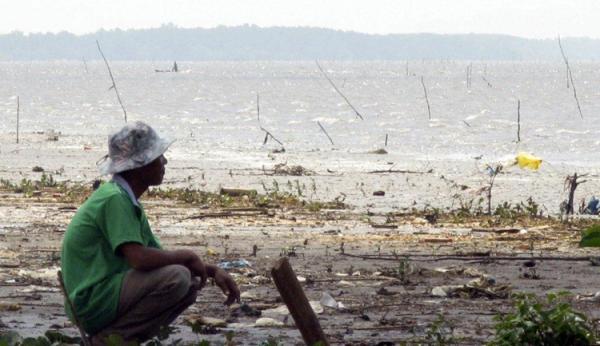 |
| Danh Hau, a shrimp farmer, has lost half of his land and shrimp to the rising sea level |
KIEN GIANG, The Mekong Delta—Along a muddy and windswept beach in a remote seaside village in the south-western province of the Mekong Delta, a one-lane dirt road divides the green arable land on one side and a beach-front on the other. It seems like any other road, but for villagers here, this is simply a much-needed lifeline, a buffer that prevents the rising seawater from swamping their homes.
Those who live behind the dyke, built by the Vietnamese government, have seen their rice fields and houses rescued from saltwater intrusion. Not so fortunate, are the families whose houses and lands are sandwiched between the wall and the sea.
“If the salty sea water goes into rice fields for even just one night, it would seem like you poured boiling water onto the rice crops, instantly killing them,” said Danh Huong, 75, who is among a number of people in Binh Giang village whose compounds are located outside ‘the safe zone’, and who have few options to live elsewhere.
Many years ago, they planted mangroves as natural protection against the saltwater.
“Now the sea comes closer and has claimed the mangroves first, and then the eucalyptuses. Now, they are all gone,” said Mr. Huong.
Beach-front residents here said they lost some of their farms to the accumulated 100-metre sea intrusion. Threatened by the rising tide, locals have invented home-grown strategies to cope with what they fear that the worst is yet to come.
Danh Hau, a 33-year-old shrimp farmer, who had lost half of his land and shrimp to the insatiable sea, decided to build two-tier dykes around fish and shrimp compounds located next to his one-storey house, where he lives with his wife and child.
“I have to make this secondary dyke because I am afraid that the waves will come back (and break the first dyke),” he said, adding that he was not sure whether this method would work out in the long run.
Dykes and mangrove forests give shelter for now. But Mr Huong and his neighbours said they live with uncertainty, fearing that they will soon be defeated by higher tides.
“We have some solutions, but the sea now is more powerful than before,” he said. “In the past during the high-tide season the sea water was much lower. Now the sea is higher and higher.”
Home to more than 17 million people, the low-lying Mekong Delta, Viet Nam’s rice bowl, is one of the world’s most vulnerable areas to rising sea levels caused by climate change.
Kien Tran-Mai, a climate change specialist at the Mekong River Commission, points out that without effective solutions, the sea level would increase by 0.8 to one metre by 2100, in which up to 38% of the Mekong Delta could end up under water. As a result, around 30% of the population will be affected and many will be forced to migrate to other areas, he said.
“These predictions are quite conservative and moderate with a certain extent of uncertainty. Other forecasts afford much worse scenarios,” he said.
The Mekong River Commission (MRC) is currently working with international and regional experts, national and local authorities, affected communities and other partner organisations in the Lower Mekong Basin to gather lessons learnt and local wisdom—how people manage to deal with more storms, floods and higher sea levels. This will enable all parties to consider applying such practical knowledge in their towns and villages.
Ky Quang Vinh, a climate change specialist of Can Tho City’s Department of Natural Resources and Environment (DONRE) and a researcher at Can Tho University, is among academics who share insights regularly with the MRC. He points out that the region is becoming much more vulnerable than before. There are now more storms and stronger typhoons and increasing erosion on the sea side.
The area is already exposed to other threats, such as rapidly growing development and urbanisation, which will likely change river flow routines, he said.
Water fluctuation changes combined with salt water intrusion will negatively affect rice farming and fishing activities, said Mr. Vinh.
“The majority of people in the Mekong Delta are rice farmers. If we don’t have solutions to actively catch up with the (growing) impact, productivity will be reduced and poverty increased,” said Mr. Vinh, adding that this will trigger increased migration from affected areas to cities.
Methods that local people are applying to deal with rising sea level and unusual floods are very basic, he said. People in this area, for example, lift their houses off the ground by attaching poles to the foundations.
“In the past there was fresh water flooding and this was a food resource for the people. But now there’s saltwater flooding, and with this things will become very different and very negative,” he said.
source: http://www.mrcmekong.org/the-mekong-basin/stories-from-the-mekong/living-on-the-edge-of-the-rising-sea/
...Read more>>>
Vietnamese Reporter Fired for Critical Essay
Reported by Chan Nhu for RFA’s Vietnamese Service. Written in English by Joshua Lipes.
 |
| Nguyen Phu Trong (L) Nguyen Dac Kien (R) |
The official Family and Society newspaper announced its decision to fire reporter Nguyen Dac Kien for “violating the rules of his contract” and said it was disassociating itself from his views in a statement issued Tuesday.
“Family and Society would like to inform its readers that Nguyen Dac Kien violated the operating rules of the newspaper and his labor contract. Therefore, the discipline panel of the newspaper convened and decided to discipline Nguyen Dac Kien by firing him,” the statement read.
“As of now, Nguyen Dac Kien is no longer with the newspaper and he is held accountable before the law for his words and behavior. Organization and individuals wishing to contact the newspaper should speak with the office directly, not through Nguyen Dac Kien.”
The announcement of his sacking came less than 24 hours after Kien’s essay, which criticized a recent speech by Communist Party general secretary Nguyen Phu Trong, became a viral sensation online in Vietnam.
‘Ready for anything’
Speaking to RFA’s Vietnamese Service on Tuesday, Kien maintained that he has done nothing wrong.
But he said that he does not blame the newspaper for removing him because of the potential fallout from his article.
“My awareness of citizen’s rights did not come yesterday or the day before—it has been a long process. The motivation to express that awareness came after listening to what [Trong] said on television,” he said.
In an address carried on national television Monday, Trong had lambasted a recent “deterioration” of the country’s morals and ethics and slammed critics who had called for the removal of a constitutional provision that underlines the leadership role of the Communist Party.
“Recently there have been some comments that have contributed to the deterioration of the political, ideological and moral environment,” Trong said.
“There are people who have called for the removal of Article 4 of the Constitution, who have questioned the Party's leadership role [and] who have called for multiparty pluralism [and] who seek separation of powers and railed against the politicization of the military,” he said.
Article 4 states that the Communist Party “is the force assuming leadership of the State and society.”
“People take these ideas and express them through the mass media. If that isn’t contributing to deterioration, what is?" Trong asked.
Kien, who is known for his nationalist views, wrote in response that Trong only had the right to criticize members of the Communist Party.
“You are the general secretary of the Vietnamese Communist Party. If you want to use the word deterioration, then you can only use it in reference to people who are Party members,” he wrote.
“If you and your comrades want to keep Article 4, maintain your leadership, politicize the military, and do not want pluralism or separation of powers, then it is your own wish and your Party’s. You can’t assume that is the wish of the Vietnamese people,” he said, adding that such views are also unlikely to represent the entirety of the Communist Party.
Kien also told RFA that despite the popularity of his article, he had done nothing especially courageous and that “anybody who is pushing for Vietnamese democracy has to make the same sacrifices I have.”
“I’m not surprised by the decision to fire me. I understand and sympathize with the leaders of the newspaper … I would like people to sympathize with the newspaper—don’t strongly criticize them, because if I were them I might have done the same,” he said.
He said he was “ready for anything” that he might face because of his decision to write the article, but said he hoped that everybody—from ordinary Vietnamese people to the leaders of government—might learn to be more open-minded and accepting of ideas different from their own.
“I’m not worried for myself, but I worry about my family—my wife, my child, and my parents. I understand the path I have chosen.” Kien said.
“My words are for everybody … In a free country, [what I did] is a normal thing. I hope we can all join hands to push for freedom and democracy in Vietnam.”
Call for change
Kien said in his article that no Communist Party document backed up Trong’s claims about moral deterioration being linked to calls for reforms.
“There is no such article that says removing Article 4 constitutes deterioration, or that pluralism and the depoliticizing of the military amounts to deterioration. Only party corruption, or when party policy works against the benefit of the people, can it be called deterioration,” he said.
In addition to the removal of Article 4, Kien called for a conference to set up a new constitution to better “represent the people’s spirit, not the Party’s” and for the implementation of a multiparty system in Vietnam.
He expressed his support for the separation of powers with an emphasis on a system that increases autonomy for local government, the elimination of state-owned corporations, and the depoliticizing of the military.
...Read more>>>
Vietnam Faces Political Entropy
Written by David Brown, YaleGlobal - THURSDAY, 21 FEBRUARY 2013
A sclerotic Communist Party resists change
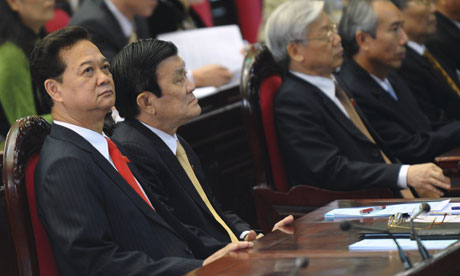 |
| Nguyen Tuan Dung, Truong Tan Sang, Nguyen Phu Trong |
With the country's earlier blazing growth slowing to around 5 percent, the public mood is bitter, openly and unprecedentedly critical. Holding a virtual monopoly over political life, the party is alone in sharing the blame for globalization gone awry.
In a scenario repeated in many countries joining the fast-moving globalized economy, Vietnam's economic crisis was heralded by a surge of foreign investment capital that - unsterilized, or offset by central bank action to reduce the money supply –led to reckless expansion of credit followed by a severe bout of inflation. Inevitably, the government was forced to retrench early in 2011.
With loans now difficult to obtain, businesses are hard-pressed to collect from clients or pay interest on what they owe. Aspirant members of the middle class have seen their savings wiped out by speculative investments gone wrong. State-owned companies are bloated, bankrupt and heavily indebted to state-owned banks. Land clearance for commercial development has been managed so ruthlessly that farmers, long a bulwark of the regime, are turning mutinous. Confidence in the party's economic management has been severely shaken.
Nor does the party retain a revolutionary aura. It is nearly six decades since the last French soldiers left a divided Vietnam and four decades since American forces exited the civil war that brought Vietnam's southern half under Hanoi's sway. Few of the nation's 90 million citizens remember those wars or care much that independence and unification was achieved under party leadership. No amount of harking back to the virtues of Ho Chi Minh and his comrades can restore the party's elan nor, it seems, root out systemic corruption.
Older Vietnamese often point out that things used to be much worse. They tend to credit the party with recognizing the failure of Soviet-style "socialism" and instituting the doimoi - or renewal - reforms that liberated latent capitalist energies and in the course of a quarter-century quadrupled living standards. Conditioned by argument that only the party's firm leadership can fend off "chaos, instability, economic disintegration and the worst crisis the nation has ever seen," most simply hope that the regime will find its footing again.
The median age in Vietnam is 28. Well over half of Vietnam's population has no experience of the pre–doimoi past. They have savored the joys of consumerism made possible by globalization. Near universal access to cell phones and the internet have freed minds. Acceptance of the political status quo is conditioned on delivery of a higher standard of living - not just material goods but also quality education, medical care and efforts to clean up the environment. Younger Vietnamese not only loathe corrupt cops, venal officials and mindless propaganda; many also can imagine a world without them.
By directing a browser to an offshore server, a citizen can tap into reassurance that such disenchantment is shared by thousands of Vietnamese bloggers and the many thousands more that post criticisms of the regime on Facebook.
It's harder to read the thoughts of party members, nearly 4 percent of the population. As a rule, they don't post comments online unless they're one of the 900 polemicists employed by the party's propaganda commission to counter "the distorted allegations of enemy forces."
It's evident, however, that a struggle is underway for the party's soul. This is not a contest linked to rival leaders Prime Minister Nguyen Tan Dung and President Truong Tan Sang, whose semi-public scrap last year over spoils and patronage obscured the larger issue: What ought the party do to defend its monopoly of political power?
The existential question is whether, once again, the party can repair itself. In 1986, reformers managed to reverse a disastrous decade-long effort to "build socialism," Soviet-style. Now, say reformers, the economic and social forces liberated a quarter-century ago require the party to cleanse its ranks, adapt its leadership style and articulate a compelling vision.
Not buying that argument, conservatives are dead set against "openness," regarded as a code word for experiments with pluralism. They oppose dismantling state monopolies in the heavy industry sector or pruning powers of the Public Security Ministry, in effect rejecting what globalization dictates.
They point to the example of Mikhail Gorbachev, the general secretary of the Communist Party who oversaw the dissolution of the Soviet Union, and East European regimes swept away by "color revolutions." Admitting any mistakes, they're apt to argue, puts the party on slippery slope; if the party's swept away, the elites could lose their pensions.
The pragmatic question is whether the party can lessen its dependence on two bulwarks of the regime that have become major liabilities: The first is the Chinese Communist Party, and the second is the state's own internal security apparatus.
Vietnam and China are linked by a web of party-to-party relationships, assiduously tended by the regime. These reflect the two regimes' ideological affinity and have, for Vietnam, served as a hedging strategy to stabilize relations with its giant neighbor. Hedging goes so far, however: In recent years, Beijing's unrelenting pursuit of its dubious claim to sovereignty over the South China Sea has frayed the Sino-Vietnamese fraternal solidarity.
Well aware that Vietnam's naval and air power is no match for China's, and that the country is highly vulnerable to economic reprisal, the regime has dodged direct confrontation. To the regime's critics, reliance on diplomacy in the face of Chinese aggression is intolerably limp-wristed.
Dissidents paint what others might regard as prudent hedging as kowtowing to Beijing. They also fault, for example, Hanoi's grant of concessions to mine bauxite in environmentally sensitive border regions, its reliance on Chinese credits, and its failure to counter Chinese harassment of Vietnamese fishermen. Many express alarm that Hanoi relies on Chinese credits and contractors to build infrastructure, allows low-quality Chinese goods to flood across the border and posts a huge bilateral trade deficit with China - $12.5 billion in 2012.
Party-to-party ties are reinforced by intimate exchanges between the Chinese and Vietnamese internal security agencies. Though it's hardly surprising that the police share experience and surveillance technologies, this cooperation provides Vietnamese dissidents a ready explanation of why Hanoi won't "stand up to China" and why it stops them from marching on the Chinese Embassy every Sunday.
Of greater concern, particularly for the party's reform wing, is the ability of the Ministry of Public Security to define threats to the regime and methods for dealing with them.
This is not just a matter of surveillance, harassment and random prosecution of bloggers and other malcontents - but also manifests itself in rejection of proposals to narrow the definition of subversive behavior in the Constitution and criminal code, definitions now so broad as to eviscerate constitutional guarantees of basic human rights.
Coincidentally, a constitutional revision process is underway, something the regime does every decade or so. This time Vietnam's public debate is far less choreographed. Remarkably, there's a groundswell of support for deleting the passage that accords the party a supra-constitutional leadership role. An unusually large number of retired party members and "revolutionary intellectuals" have signed on to the idea.That sort of political opening won't happen now, but the current ferment suggests that its time may yet come.
(David Brown is a retired American diplomat and frequent Asia Sentinel contributor who writes on contemporary Vietnam. He may be reached at nworbd@gmail.com. This is reprinted with permission of the Yale Center for the Study of Globalization.)
...Read more>>>
Southeast Asian countries stock up on arms as they face off with China
By Greg Torode, Chief Asia Correspondent, the SCMP.com Feb 9,2013

Two Russian-built Kilo submarines cruise the dark, frigid waters of the North Sea out of Kaliningrad, being readied for delivery later this year to Vietnam, where Indian technicians are already helping to train Vietnamese crews.
Down in the Philippines, meanwhile, final preparations are under way to seal a deal to buy a squadron of jet fighters from South Korea and receive three naval helicopters from Italy.
As Southeast Asia's military build-up intensifies to counter China's military rise, it is increasingly clear that it has an international dimension, tying China's neighbours to a widening range of relationships that could complicate Beijing's strategic environment.
"There is certainly a strong international component to these developments in Southeast Asia," said Richard Bitzinger, a senior fellow at Singapore's S. Rajaratnam School of International Studies, who is tracking a growing list of acquisitions across the region. "Southeast Asia is a very open arms market compared to other parts of the world like the Middle East … there is no shortage of potential sellers, and plenty of interested buyers.
"And in this business, you don't want to be dependent on any one supplier, so that explains all the shopping around. Price is, of course, another factor."
Vietnam has long attempted to diversify its sources as it rebuilds its once-formidable military, reflecting a marked internationalist cast to its foreign policy, avoiding alliances and over- reliance on any one major actor.
Military hardware recently or soon to be acquired or deployed in Southeast Asia
Hanoi has looked to Moscow - its cold war-era patron - for key elements of its state-of-the-art kit, including frigates and Sukhoi jet fighters, as well as the Kilos. But it is also tapping India for anti-ship cruise missiles and talking to various European nations, including France, for ships and radars and has lobbied Washington hard about lifting restrictions on weapons sales - a legacy of the Vietnam war.
One representative of a major US weapons manufacturer said there was considerable US interest in potential business from Vietnam, but State Department officials have told them they must wait for improvements in the Communist Party-ruled nation's human rights situation.
For the Philippines, however, its move into the international arms market is something new - and a factor that is surprising analysts. A US ally tied to Washington by a decades-old security treaty, Philippines' leaders have long ignored calls to update its tiny and creaking armed forces, relying on the occasional infusion of surplus US materiel.
President Benigno Aquino is determined to challenge that perception, pushing ahead with bold plans to gradually increase defence spending after years of atrophy. The US$443 million deal to buy the South Korean FA-50 light fighter jets will give the Philippines its first meaningful air attack capability in the best part of two decades. The planes are also a perfect training platform for more advanced F-16s from the US – another deal in the frame.
The jet purchase is being matched by other moves, including buying 10 coastguard ships from Japan under an aid deal, and talks with a host of other nations about possible purchases. The significance of a Russian naval task force visit to Manila Bay a year ago - the first such mission in 96 years - was not lost on military analysts.
"The amazing thing is not just that they are buying from a range of countries, but it is amazing that they are buying at all," Bitzinger said.
And then there is Indonesia. Southeast Asia's largest nation has been active as well, purchasing submarines from South Korea, anti-ship missiles from China, Sukhoi jets from Russia and F-16s from the US.
Bitzinger noted that Indonesian defence spending rose 200 per cent in the decade to 2010, reaching US$6 billion and boosting regional figures that saw spending across Southeast Asia rise more than 50 per cent during the same period.
The trend looks set to expand. Bitzinger said he expected Indonesia, Vietnam and possibly oil-rich Brunei to significantly increase defence spending, with Indonesia overtaking traditional military heavyweight Singapore as the biggest player.
Officially, of course, it is not targeted at China. As Aquino spokesman Edwin Lacierda said last week: "The military upgrade was already a priority before our incident with China … It is not aimed at any particular country. It is our obligation to modernise our military hardware."
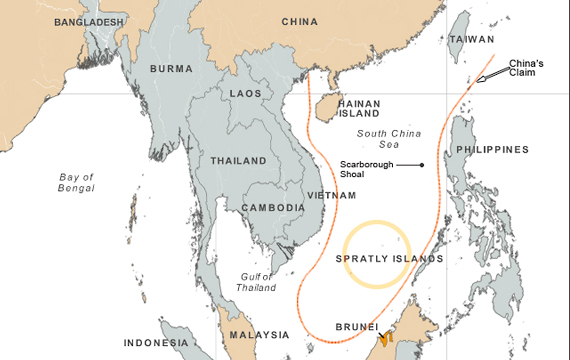
But speak privately with military brass and strategists across the region and the spectre of China's vaunted military ambitions - fuelled by two decades of double-digit spending rises - looms large. Vietnam and the Philippines, of course, are locked in increasingly tense territorial disputes over the South China Sea, along with fellow claimants Malaysia and Brunei. Philippine officials have described their sovereignty as being under direct threat as Chinese ships maintain a permanent presence in the disputed Scarborough Shoal, within the Philippines' claimed exclusive economic zone.
Given the reach of China's controversial "nine-dash line" claim deep into the maritime heart of Southeast Asia, countries such as Singapore and Indonesia look on nervously.
"No one of us is ever going to be in a position to challenge China militarily," one Vietnamese strategist said. "What we can do is create a strategic deterrent that would make them think very long and hard before contemplating even a limited conflict to enforce their claims. That's what we are doing … as well as reminding China now and then that we would be prepared to fight to defend our sovereignty."
Vietnam's dynamic deputy defence minister, Lieutenant General Nguyen Chi Vinh, has already stated, in a clear nod to China, that if any party escalated the dispute, "we would not stand by and watch".
While Vietnam is well on the way to such a position, the Philippines still has a long way to go, as the Scarborough Shoal situation suggests. In creating that deterrent, countries are effectively trying to do to China what China is trying to do to the US, whose military remains the most powerful in the wider Asian region.
Through the use of so-called asymmetric weapons such as a submarines and anti-ship missiles, a larger foe can be deterred - as China hopes the US would be in case of a conflict over Taiwan
Professor Carl Thayer, who has been monitoring the build-up at the Australian Defence Force Academy, recently described it as a "cycle of action-reaction", driven in large part by China's military rise and assertiveness. It is not about ultimate supremacy, so it can not be seen as a classic arms race.
"But neither Vietnam nor Indonesia are straining their economic resources to develop their armed forces," he said. "And to both Vietnam and Indonesia, China creates a security dilemma but it is not an adversary."
Major international weapons manufacturers and exporters have been increasingly active across the region, appearing behind the scenes at high-profile gatherings such as the informal Shangri-La Dialogue in Singapore, an annual gathering of defence ministers, top military brass and scholars.
"In the last year or so, I've noticed the smiles on the faces of my peers working the region are getting broader, and their cigars bigger," said one regional representative of a large US weapons and systems manufacturer.
"It's nice to be in a growth industry."
...Read more>>>
A Group of 20 Vietnamese Men Attacked Khmer Krom Monks

In Vietnam, Draconian Decree Would Clamp Down on Blogs, Online Speech
By Simon Roughneen, PBS.ORG - February 11, 2013

Such coverage sheds light on how the media works in the one-party state where online writing has filled a void. In state-run mainstream media, topics such as power struggles within the ruling Communist Party and relations with China are often taboo, and challenges to authoritarian rule are dismissed with old-school Soviet slurs.
Professor Ben Kerkvliet, a Vietnam specialist at Australian National University, told MediaShift that "my sense is that the Internet has enhanced knowledge and awareness among many Vietnamese, especially younger ones and urban folks, about shortcomings of various levels of government. Many Vietnamese now get news from a variety of sources, ranging from government and party-run papers and magazines to unauthorized blogs and newspapers to international news organizations."
But new measures currently being considered by the government could tighten restrictions on Vietnamese who want to speak their minds online.
In April 2012, the Ministry of Information and Communication introduced the Decree on the Management, Provision, Use of Internet Services and Information Content Online, which in its first reading would force foreign content providers to increase cooperation with Vietnamese officials by removing content deemed illegal and potentially housing data centers within the country. The proposed code could require users to use their real names online, chilling free speech.
CONTRASTING COVERAGE
Phan Van Thu, the group leader referenced in the headline, was part of a group of 22 deemed subversive by the Vietnam government. The rest of the group got jail terms of 10 to 17 years, meted out by the People's Court in Phu Yen Province after a week-long trial.
According to the Vietnamese media, "the defendants were accused of running the reactionary political organization between 2004 and February 2012, operating as a branch of an eco-tourism company." And in what is usually a red flag for the Vietnamese government, the report said the group "received financial contributions from a number of overseas Vietnamese."
In contrast to domestic coverage, international news reports described the group, known as the "Bia Son Council for Public Law and Affairs," as dissidents or activists -- the latest to become part of a drive by the Communist Party of Vietnam to shut down groups who disagree with how the country is run.
For Vietnamese accused of having links to foreign-based organizations that the Communist Party sees as threats to its power -- such as the U.S.-based Viet Tan -- incarceration is usually the outcome.
Bill Hayton, author of "Vietnam: Rising Dragon," told MediaShift that "while the Vietnamese security apparatus is prepared to tolerate protest and criticism it is absolutely intolerant of dissidents working with foreign organizations, particularly those based in the United States. I think its pattern of behavior and its decisions about which dissidents to arrest is intended to draw a clear distinction between 'legitimate' dissent and 'illegitimate' treachery."
The accused were assigned a lawyer by the government, Nguyen Huong Que, who said after the verdict was announced that "the sentences are adequate for their crimes."
Intriguingly, the group was described by human rights activists as followers of Nguyen Binh Khiem, a 16th-century Vietnamese version of Nostradamus, who "dreamed of building a new 'Utopia' in which science, nature and humankind would be harmoniously balanced."
MORE ARRESTS
In January, 14 activists and writers were sentenced to up to 13 years in prison, though in the meantime the Vietnamese government freed U.S. citizen and Viet Tan member Nguyen Quoc Quan after nine months in prison. That was followed by the February 6 freeing of lawyer Le Cong Dinh, who was detained since June 2009.
Despite the releases,, however, Vietnam's human rights situation is getting worse, said academic Carl Thayer, a prolific commentator on Vietnamese politics "This year alone at least thirty-six persons have been sentenced to prison on trumped up charges of attempting to overthrow the socialist state," he wrote in a new research note.
When Vietnamese citizens voice anger about land grabs and corruption in Vietnam, they are sometimes tolerated, sometimes not, in what is an opaque legal culture. Sometimes journalists in the mainstream press cover these issues -- though it is not clear to what extent such coverage is approved in advance by authorities or to what extent the coverage is linked to faction-fighting or vendettas within the Communist Party.
But for some who write scathingly about alleged government malpractice, incarceration is often the outcome. Le Anh Hung was arrested in late January and is being held at a psychiatric institution in Hanoi -- a form of detention reminiscent of Soviet-era practices. Le was subsequently freed on February 5.
Le Quoc Quan, a lawyer based in Hanoi, spoke to MediaShift in 2012 about the importance of online media in Vietnam where print and TV is linked to or run by the Community Party of Vietnam, the only political party in the country.
"The citizen's press, non-official press, posting via social networks, SMS, Facebook, and blogs is an ongoing development and playing a more and more important role in the society," said Le Quoc Quan last September. Le Quoc Quan was arrested in late January on tax-related charges - allegations that human rights groups say are trumped-up - and has been held incommunicado since.
NEW MEASURES
Online sources have filled the void created by party-run media, but that too is now threatened.
For Vietnamese already used to restrictions, the proposed code could require users to use their real names online and for bloggers to post their real names and contact information on their blogs -- a potential game-changer for Vietnamese who, caught between not wanting to go to jail and wanting to write honestly, use pseudonyms when writing online.
One motivating factor in the government's drive to force people to write under their real name could be allegations posted on blogs last year - which were later refuted - that Prime Minister Nguyen Tan Dung's daughter put money into a controversial residential development project outside Hanoi.
However the initial draft contained vague catch-all provisions seemingly aimed at deterring commentary that could question the government, prohibiting Internet users from "undermining the grand unity of all people," or from "undermining the fine customs and traditions of the nation" as well as "abusing the provision and use of the Internet and information."
Soon after the decree was first announced, 12 U.S. lawmakers, both Republicans and Democrats, wrote to Facebook, Google and Yahoo, saying, "We strongly urge you to advocate for the freedoms of speech and expression for the citizens of Vietnam by continuing to provide your technologies to the people of Vietnam in a manner that respects their rights and privacy."
COUNTERPRODUCTIVE?
Part of the reason Vietnam's government seems so intent on crushing those who suggest an alternative form of government is economic -- numerous corruption scandals and slowing foreign investment forced a public apology from the ruling party last autumn and prompted speculation that if the economy stalls longer-term, more Vietnamese could question one-party rule.
But tightening the net too tautly around the web could prove counterproductive for Vietnam's "emerging economy."
Research by the McKinsey & Co. consultancy estimates that the Internet "contributes an average 1.9 percent of GDP in aspiring countries," based on a survey of nine states, including Vietnam.
...Read more>>>
Asia Surge: US Marines Heading to Vietnam, Cambodia
US Hopes to Increase Presence Across Pacific
by Jason Ditz, AntiWar.Com- February 06, 2013
The US Marines currently have two battalions “permanently” deployed across the Pacific Rim, mostly Okinawa and Guam. This will be increased to add a third battalion, with an increase in troops in Okinawa, as well as Vietnam and Cambodia.
The Vietnam mission is scheduled for July, and will center around training locals in disposing of unexploded land mines still littering the nation since the US war in that nation a generation ago, while the Cambodia deployment will increase US ties with the regime there.
Amos expressed hope that the Vietnam deployment would build relationships to the point where the Marines could establish a training and operational relationship with the Vietnamese military, while Lt. Gen. Terry Robling says that deployments into Malaysia, Indonesia and even India are also “on the horizon.”
...Read more>>>
China Buys Cambodia
Source: Strategypage.com

China has built over 200 of the Z-9s and many have been armed (with twin 23mm cannon, torpedoes, anti-tank missiles, and air-to-air missiles). The Z-9WE is the export version which is modified to more easily accept Western electronics and weapons. Cambodia is initially receiving the transport version of the Z-9.
China is the main supplier of military equipment to Cambodia. The U.S. had been ready to supply this material but backed off because of the corruption and mismanagement of the Cambodian government. That sort of thing does not scare off the Chinese. Moreover, the Chinese need some allies in this part of the world, because most other nations are uniting against Chinese claims to control the entire South China Sea. Cambodia has no problem with that because it has no seacoast on the South China Sea (just the Gulf of Thailand). Thus Cambodia is the only nation in Southeast Asia that is not hostile to China. ...Read more>>>
Vietnam frees human rights lawyer
| Le Cong Dinh |
Vietnam on Wednesday freed a prominent human rights lawyer who served more than three years of a five year sentence for trying to overthrow the regime, his family said.
"He was freed before Tet (Lunar New Year) and because his mother's health is poor," said Dang Ngoc Anh, the sister-in-law of lawyer Le Cong Dinh, 44.
Dinh was one of four democracy activists convicted in January 2010 at a day-long trial in southern Ho Chi Minh City that was was condemned by human rights groups and the European Union.
Dinh, whose sentence also included three years of house arrest after his release from prison, had been detained since June 2009.
Dozens of activists have been jailed since Vietnam -- a one-party state that forbids political debate -- began a new crackdown on free expression in late 2009.
According to New York-based Human Rights Watch, Vietnam jailed at least 33 activists in 2012 based on vaguely defined articles in its penal code that criminalise the exercise of civil and political rights.
On Monday Vietnam sentenced 22 activists to lengthy jail terms ranging from 10 years to life imprisonment, after one of the country's largest subversion trials for years.
Rights groups say charges of spreading anti-state propaganda and attempting to overthrow the regime are routinely laid against peaceful dissidents in Vietnam.
...Read more>>>
Cambodians Pay Tribute to King, but Heed Hun Sen
By CHUN HAN WONG, Wall Street Journal
January 31,2013
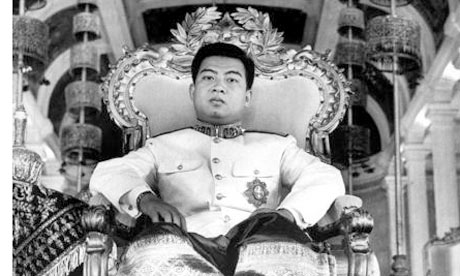 |
| Former King Norodom Sihanouk |
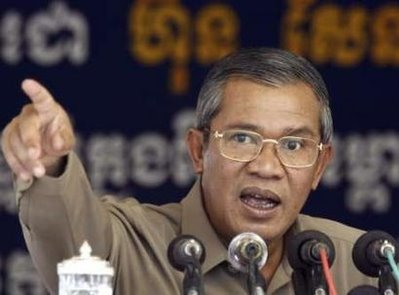 |
| Cambodian Dictator Hun Sen |
"The king has some power," Seourn Sok, a 25-year-old construction worker in Phnom Penh, said of the ex-monarch, who gave up his throne to his son Sihamoni in 2004 and died in October at the age of 89. "But far less than Hun Sen."
Only 60 years old, Mr. Hun Sen already ranks among the world's longest-serving leaders. Since taking office in 1985, he has become known by rivals and supporters alike as a Machiavellian operator who presided over Cambodia's recovery from civil war and genocide but who also quashed dissent and outmaneuvered opponents. He has done so, rights groups say, using cronyism, violence and intimidation.
"Hun Sen's leadership is very much a one-man show, and he decides on almost everything," said Lao Mong Hay, a Cambodian academic and political analyst. "His administration is like a cluster of fiefdoms" run by his cronies, Mr. Mong Hay said.
Mr. Hun Sen didn't respond to requests for an interview.
The prime minister and his Cambodian People's Party are the only power that most of Cambodia's 14.5 million people have known. Along city streets and rural lanes, his portrait is splashed on royal blue billboards. Mr. Hun Sen appears almost certain to receive another five-year mandate in a national election set for July: The CPP handily won senate and local elections last year, while a late-2011 poll by the U.S. government-funded International Republican Institute found that 81% of 2,000 Cambodians surveyed felt the country was on the right path.
Mr. Hun Sen's political dominance is welcomed by many local tycoons and even some foreign investors who credit him for restoring stability and enabling economic growth that has ranked among Asia's fastest in the past decade.
"What there has been over the years is tremendous continuity in the government. In a place like Cambodia, it's probably a good thing to have that stability," particularly because state institutions are weak, said Brett Sciaroni, a Phnom Penh-based American lawyer who advises Mr. Hun Sen's government on business and investment issues.
Cambodia ranks among the world's least developed countries, with about 30% of the population living below the poverty line and international aid providing roughly half the annual budget.
Development has been marred by allegations of abuse of power. In a November report, Human Rights Watch blamed Mr. Hun Sen and his supporters for more than 300 politically motivated killings since 1991, when a United Nations-brokered agreement ended a civil war. The rights group also accused the government of manipulating the judiciary and police.
Activists and Western aid donors accuse the government of neglecting development goals and pursuing environmentally destructive policies, such as granting concessions to local and foreign companies seeking timber, cash-crop and mineral resources.
Mr. Hun Sen has dismissed such claims. He defended his rights record during a meeting with President Barack Obama in Phnom Penh last year, saying Cambodia has unique circumstances that drive domestic policies, according to the White House. The prime minister has also played down the impact of the controversial land leases, although in May he suspended grants of new leases and said authorities would confiscate concessions that involved illegal land grabs.
The son of peasants, Mr. Hun Sen joined the Khmer Rouge in 1970 and lost an eye while fighting Cambodia's then pro-U.S. government. He defected to Vietnam in 1977 to escape internal Khmer Rouge purges, returning two years later as part of a Vietnamese invasion that toppled Pol Pot's genocidal regime. He served as foreign minister in the new Hanoi-backed government before becoming premier.
Mr. Hun Sen faced few serious challengers until U.N.-backed elections in 1993 forced his CPP, which placed second, into a coalition with a royalist party. Mr. Hun Sen wrested full power four years later in a brief but bloody skirmish. The CPP won the next three elections—most recently in 2008, when it took 90 seats in the 123-member legislature.
The formerly Communist CPP boasts branches across Cambodia's vast rural districts and in urban centers. The party appears to have handily outspent the opposition on campaigns, and it enjoys the support of tycoon-controlled broadcasters whose stations dominate the country's television and radio waves. One broadcaster is headed by Hun Mana, a daughter of the prime minister.
In recent years, China's generous support for the government—mainly through aid loans and infrastructural investment—has also bolstered the ruling CPP's development agenda.
A chess player and a heavy smoker, Mr. Hun Sen has said he plans to rule until he is 90. Many Cambodians think he will eventually try to hand power to his children. Eldest son Hun Manet, 35, is a graduate of the U.S. Military Academy at West Point—which admits some international cadets—with an economics doctorate from the University of Bristol. Mr. Hun Manet heads the Cambodian military's counterterrorism arm and is deputy chief of his father's personal bodyguard unit.
Still, Mr. Hun Sen's challengers remain hopeful. Rural discontent has grown over alleged land grabs by private corporations. With steady economic growth producing an increasingly urban and better-educated population, the electorate could demand greater accountability and transparency.
Opposition leader Sam Rainsy, a former finance minister, led a merger of the country's two main opposition groups last year to form the Cambodia National Rescue Party. Mr. Rainsy is exiled in Paris due to what he and rights observers have called a politically motivated conviction in 2010 for spreading disinformation and falsifying the Cambodia-Vietnam border on a map. Mr. Rainsy said in an interview that the opposition enjoys "strong popular support."
But analysts aren't convinced the French-educated former fund manager can win sufficient backing from Cambodia's rural poor. In the 2008 parliamentary election, the Sam Rainsy Party received 21.9% of valid ballots while the Human Rights Party took 6.6%, combining for just 29 seats.
— Sun Narin contributed to this article.
...Read more>>>
Democracy Activist Released and Deported from communist Vietnam
RFA - January 30,2013
Authorities send the opposition member home after nine months of detention.
 |
| Nguyen Quoc Quan was detained in Saigon (Prey Nokor) City, |
Nguyen Quoc Quan, 59, was arrested on April 17 last year as he deplaned in Tan Son Nhat airport and charged with terrorism for allegedly trying to disrupt the anniversary of the fall of Saigon at the end of the Vietnam conflict.
Also known as Richard Nguyen, Quan is a member of the Viet Tan Party—a U.S.-based opposition group outlawed in the one-party communist state, and which credited “immense international pressure” for his release.
"Vietnam has expelled Nguyen Quoc Quan, who is an American citizen," the state-run Vietnam News Agency said in an online report Wednesday.
"Quan admitted his crimes, asking for leniency so that he could go back to the United States and be with his family," the report said, without providing additional details.
Following his arrest last year, state media reported that Quan “had schemes to execute some demonstration and terrorist activities planned by the overseas terrorist organization Viet Tan” to mark the April 30 anniversary of the fall of the U.S.-backed regime in southern Vietnam.
It said Quan’s plot had been revealed through an investigation by the Ministry of Security and that he subsequently “admitted to his involvement in the criminal activities.”
In August, Vietnamese authorities “quietly” changed the democracy activist’s charges from terrorism, under Article 84 of the Vietnamese Penal Code, to subversion, under Article 79, for merely being a member of Viet Tan.
He was due to go on trial earlier this month but the proceedings were cancelled without official explanation.
Release welcomed
In a statement Wednesday, Viet Tan expressed gratitude to the international community for exerting pressure on the Vietnamese government to secure Quan’s freedom.
“After months of illegal detention with limited access to legal counsel, Dr. Quan’s release comes amidst immense international pressure for his case,” the statement said.
“Viet Tan opposes the illegal detention of Dr. Quan and strongly rejects the Hanoi regime’s attempt at smearing the peaceful activities of Viet Tan.”
Quan’s U.S.-based attorney Linda Malone called the activist’s release “a major and wonderful surprise,” particularly in light of the Vietnamese government’s ongoing trial of 22 members of an obscure environmental group for trying to “overthrow” the country’s communist leadership and convictions of others on similar charges this year.
“Vietnamese authorities have been quoted as saying that he had admitted to his charges and asked for leniency,” Malone said.
“His wife has noted that this is patently untrue as, if he had admitted to the charges, he could have been released months ago,” she said.
Malone said media attention, public concern, and the efforts of the U.S. State Department had been “critical in preventing conviction of a U.S. citizen for exercising a clearly protected human right to freedom of speech and thought.”
Quan, who received his doctorate in mathematics from North Carolina State University, is a former high school teacher in Vietnam.
He was previously detained by Vietnamese authorities in November 2007 and held for six months for distributing materials promoting nonviolent tactics for civil resistance before being deported in May 2008.
Crackdown
Vietnamese authorities have jailed dozens of political dissidents since launching a crackdown on freedom of expression at the end of 2009.
Earlier this month, a court convicted 14 activists, including Catholics, students, and blogger under Article 79 for their involvement with Viet Tan. Nearly all of them were ordered jailed for between three and 13 years in prison.
Article 79 forbids “carrying out activities aimed at overthrowing the people’s administration” or establishing or joining organizations with the intent to do so.
Rights groups say Article 79 has been used in the past as a pretext to repress and silence peaceful democratic voices.
Reported by Joshua Lipes.
...Read more>>>
Vietnamese intellectuals and Catholics sign a petition for the end to single party rule
by AsiaNews.it
January 25,2013

At least 800 Vietnamese personalities call for constitutional reform, with the separation of state powers. Appeal joined by Bishop of Vinh and vicar general of Saigon. Bishop Nguyen Thai Hop calls for "full respect for religious freedom." A few sites that have re-published the petition censored by the government.
Hundreds of intellectuals, religious leaders and political leaders in Vietnam have signed an online petition, which call for a revision of the national Constitution and a multi-party system, separating the executive, legislative and judicial powers. Among the points for reform, is also the reform of land ownership (now in the hands of the State) and the demand for full religious freedom still subject - in the practice of worship - to state control. Among the more than 800 signatories are also prominent Catholic Church figures: among them the Bishop of Vinh Msgr. Paul Nguyen Thai Hop, Fr. Mary Joseph Le Quoc Thang of the Episcopal Commission for Justice and Peace and Fr. Huynh Cong Minh John Baptist, vicar general of the Archdiocese of Ho Chi Minh City.
Published recently by a popular Vietnamese site, the petition stems from an appeal made by the same communist authorities in Hanoi, for "public suggestions" to amend the Constitution. Among those who signed the document is the former Minister of Justice Nguyen Dinh Loc who states "it is obvious that changes must be made," and it is "only to understand to what extent."
The current basic charter of the State was enacted in 1992, but there have been no changes of any kind in at least 10 years, despite the events and changes that have marked the recent history of Vietnam. "Now - said the former state official in an interview with Radio Free Asia (RFA) - it is time for radical changes" among which he includes also the name of the country, the current Socialist Republic of Vietnam to the previous "Democratic Republic of the Vietnam".
The authorities report that there is time until March 31 to submit comments on the constitutional review process, which should be promulgated - the new form - in the month of May. However, some "sensitive" points such as multi-party elections, improvements in land ownership rights - with a return to the Charter of 1946 - and other elements of tension are "excluded" from debate. Local sources also add that "many websites [critical of the Communist leadership] that published the petition were censored."
At the forefront in the promotion of the on-line petition were faithful and figures of the Vietnamese Catholic Church, including the Bishop of Vinh in central Vietnam. Bishop Paul Nguyen Thai Hop emphasizes that "it is the right of the people, not only of a political party" to address the Constitution, which must then be "submitted to a popular referendum" before the entry into force. The prelate hopes that the new formula provides "more religious freedom in the country" and that it will follow UN guidelines, Vietnam being "party to the International Covenant on Human Rights." "The Constitution - said the bishop - should be modified for Vietnam to integrate better internationally, as well as to comply with the conventions it has signed."
...Read more>>>
California city councilman aims to block Vietnam officials' visit
By Anh Do, Los Angeles Times
January 23, 2013, 9:01 p.m.
Mayor Pro Tem Michael Vo objects to an invitation to business and government officials from the city's Chamber of Commerce and warns of possible unrest.

Mayor Pro Tem Michael Vo said an official visit from a country "without human rights and respect for freedom will not be accepted by the Vietnamese community, many who live here."
Vo said it would be fiscally irresponsible to pay for police services for a likely protest, which he predicted could draw hundreds.
"I cannot be silent and let this happen under my watch," added Vo, the first Vietnamese American member of Fountain Valley's City Council.
In a letter to council colleagues and directors of the city Chamber of Commerce, he wrote: "I will not stand by to have any foreign government take advantage of our businesses and of our Chamber of Commerce, disrupt the peace and the tranquillity ... and drain this community of its financial and human resources."
At the invitation for the chamber, the delegation is set to visit the city in March.
Mayor Mark McCurdy said he'd just learned of Vo's concerns and is yet unsure whether he supports the effort to block the delegation.
Chamber officials plan to open their office to host a reception for the guests, City Manager Ray Kromer said in an in-house memo to the council. "We understand that the plan so far is to keep this relatively low-key. We need to assess how the community will react."
Mary Parsons, president and CEO of Fountain Valley's chamber, said the visit is not confirmed, adding that she and the board's executive committee plan to meet soon on the matter.
Ken Duong, an attorney and chairman of the chamber's board, declined to comment. Vo targeted Duong in his note, saying that he owns "a law firm which is focused on international business & immigration and that generating global network is important."
When a theater troupe from Vietnam visited Fountain Valley in September, nearly 300 demonstrators swarmed the Saigon Performing Arts Center, vocally attacking the visitors from Ho Chi Minh City. It cost the city $8,000 in police services to control the crowd, Vo said.
He also cited the demonstration outside Hitek TV & VCR in neighboring Westminster in 1999, when more than 15,000 people united against a Little Saigon merchant displaying the Communist flag and a picture of Ho Chi Minh at his video store. City officials there paid almost $200,000 for overtime police, among other expenses, during 53 days of protest.
In recent months, officials in Westminster and Garden Grove have passed legislation requiring advance notice of visits from communist delegations so police have time to prepare. Vo said he plans to introduce a similar ordinance in Fountain Valley. The heavily Vietnamese community known as Little Saigon reaches into all three cities, as well as Santa Ana.
anh.do@latimes.com
...Read more>>>
Vietcong Leader Meets Pope Benetic XVI
BY CNA/EWTN NEWS 01/22/2013
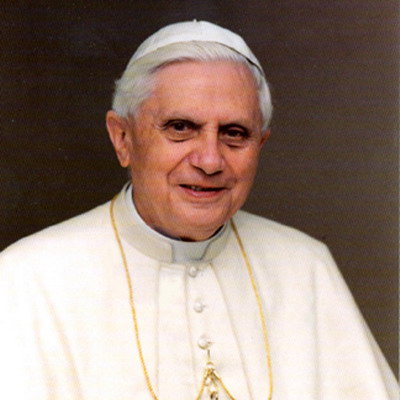 |
| Pope Benetic XVI |
The Pope spoke with Nguyên Phú Trong on Jan. 22, who then met with Vatican Secretary of State Cardinal Tarcisio Bertone and Archbishop Dominique Mamberti, secretary for relations with states.
The Church leaders addressed with Trong their hopes of strengthening the existing fruitful cooperation between the two states.
Trong’s audience with the Pope was unusual in that he is a political leader and not a head of state with whom Pope Benedict would usually meet.
His visit with Pope Benedict is part of a wider European tour he is conducting with another nine members of the Communist Party of Vietnam. Trong met with Italian authorities on Jan. 21 and will end his European trip with a visit to London on Jan. 24.
A Vietnamese delegation from the office in charge of religious affairs visited the Vatican just two months ago.
The Holy See has not had full diplomatic ties with Vietnam since 1975, though in 2011 Archbishop Leopoldo Girelli, apostolic nuncio to Singapore, was appointed the Vatican‘s “official” to Vietnam.
“Most Vietnamese will say, ‘Well, this is just another meeting,' but it’s the first time a secretary general, the most powerful member of the Communist Party, visits the Pope,” Father Cuong Pham, a priest of Vietnamese descent, told Catholic News Agency Jan. 22.
“I think we should give them the benefit of the doubt that there is a sincere desire to improve relations and engage the Church with the Holy See,” he added.
Difficult Situation
Vietnamese Catholics, who constitute some 7% of the nation‘s population, often face persecution from the atheist government.
Father Pham, who works in Rome, said the situation for Catholics there remains difficult.
“The situation has worsened because there is a big faction among members of the government that is hostile to religion as a whole, and they feel like the Catholic Church is becoming too prominent,” Father Pham noted.
“By limiting the Church’s role, they want to show that the government is in charge because they don’t think that any religious group should have that type of influence,” he added.
And, according to Father Pham, there are more tensions on a local level than on a government level.
“In several areas of the country, there have been cases of abuse on high levels, which even violate Vietnamese law and the constitution,” said the priest.
He also observed that meeting with the Pope could perhaps change public opinion about Vietnam‘s human-rights abuses.
“It makes the Vietnamese government look good and also that they are solicitous towards the Church and respecting freedom of religion, although that’s only on the surface, and we don’t know if it will translate into action,” Father Pham said.
“The average Vietnamese would hope that the Holy Father has used the opportunity to speak for them, who are voiceless.”
...Read more>>>